
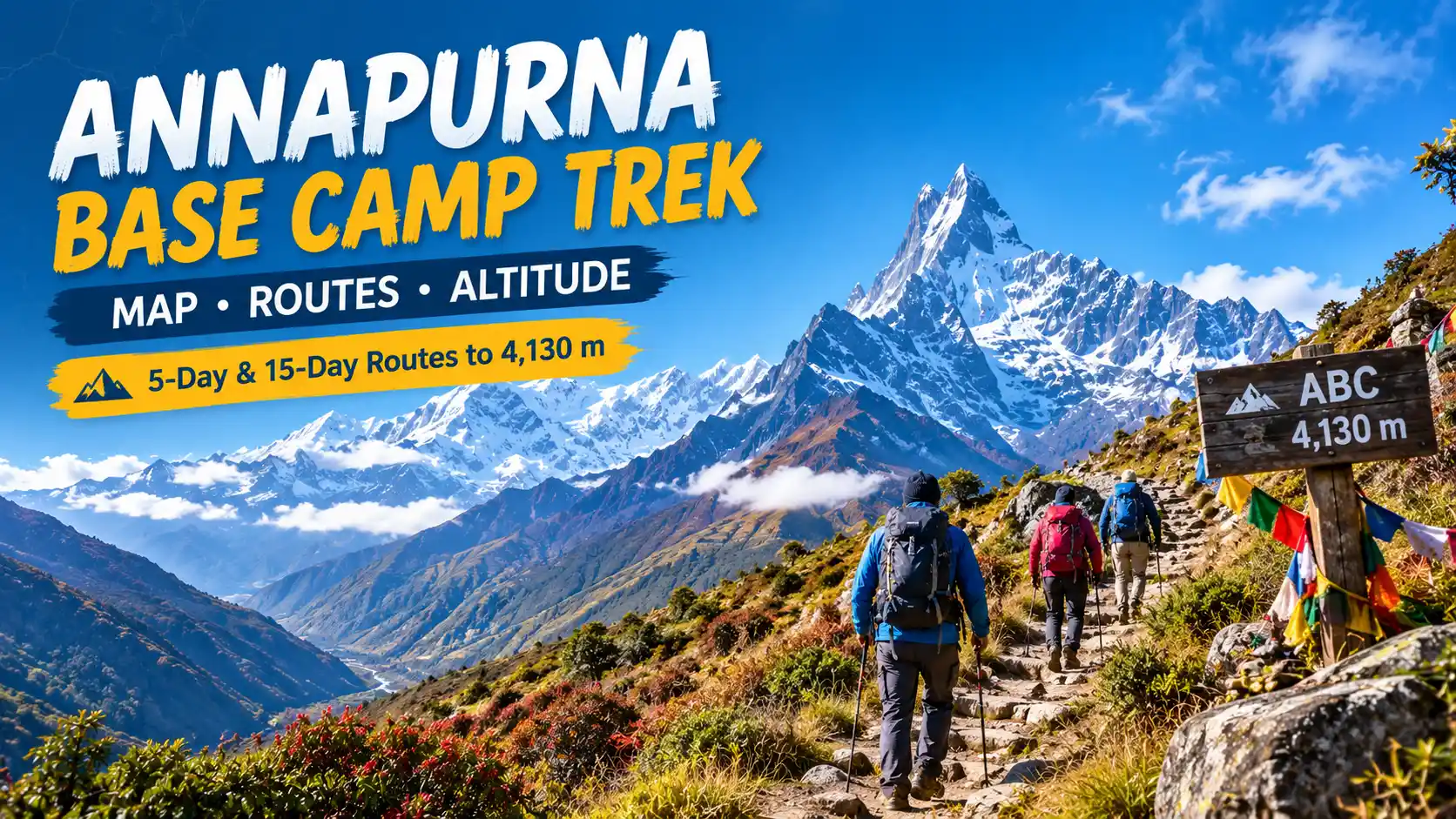

Annapurna Base Camp sits at 4,130 meters in the Annapurna Sanctuary, deep in the Annapurna Conservation Area of central Nepal. The Annapurna Base Camp trek map shows how you get there: the road sections, the trekking trail, the overnight stops, and the altitude you gain each day.
This guide uses two real itineraries, a 5-day route and a 15-day route – to show how the map actually works in practice. You will find the distance, walking hours, and elevation change for each day, along with an altitude chart that shows exactly where the trail climbs the most.
By the end, you will know:
- The route for both the 5-day and 15-day ABC trek
- How far you walk each day, and for how long
- Where the altitude rises fastest, and why that matters
- The main route variations, including the Poon Hill option
- What the map shows well, and what it does not show at all
Annapurna Base Camp Trek Map: 5-Day and 15-Day Routes
The map above shows two different ways to reach the same destination. Both routes pass through Sinuwa, Deurali, and Machhapuchhre Base Camp (MBC) before reaching ABC. The difference is what happens before and after that core section.
5-Day Annapurna Base Camp Route 
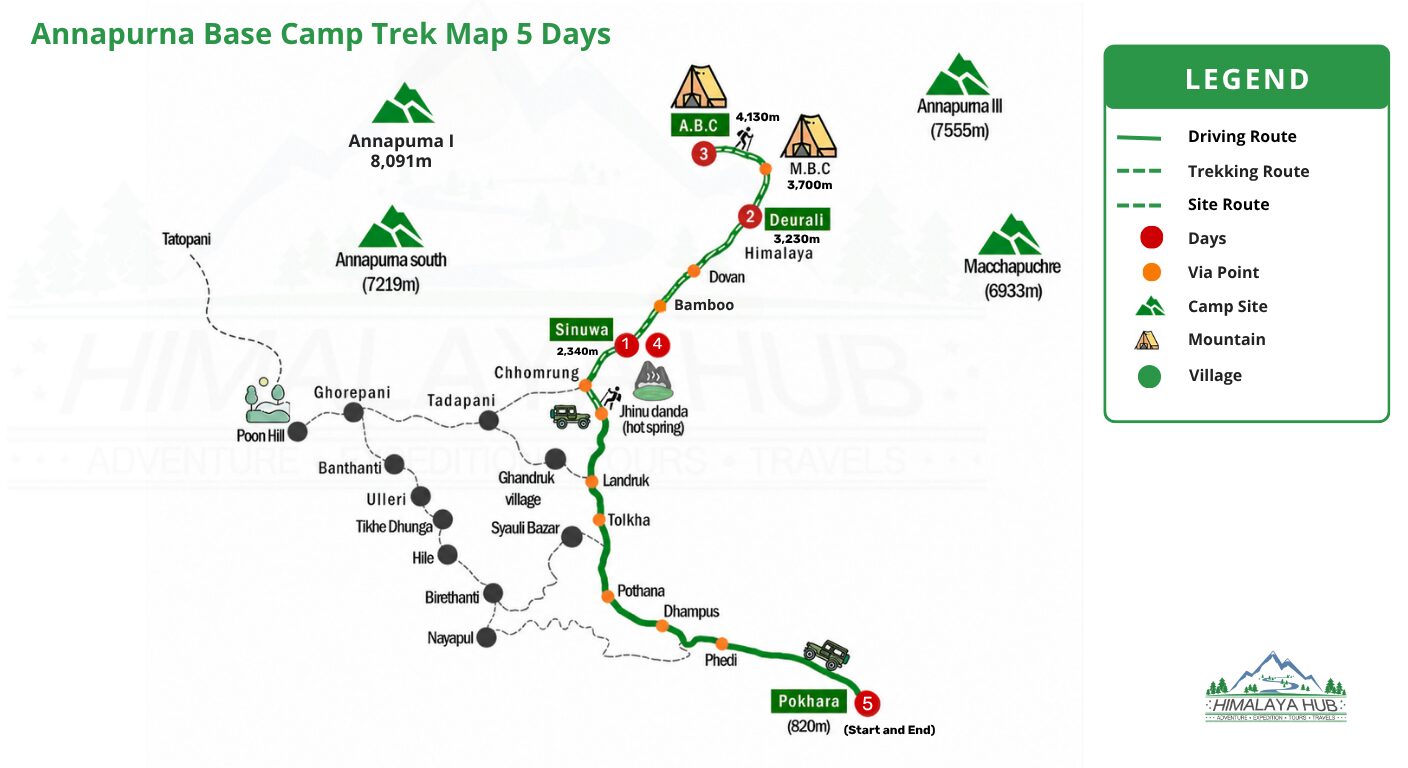
Pokhara → Siwai → Sinuwa → Deurali → Annapurna Base Camp → Sinuwa → Jhinu Danda → Pokhara
This route starts with a short drive from Pokhara to Siwai. From there, you trek uphill through Chhomrong village and reach Sinuwa on the first day. The next three days follow the direct trail through Deurali and MBC to reach ABC, then return the same way.
There is no Poon Hill section on this route. The schedule is built for trekkers who want to reach ABC and come back in the shortest reasonable time.
- Starting point: Siwai (reached by drive from Pokhara)
- Highest altitude: 4,130 m at ABC
- Trek days: 5
- Route style: Direct, out-and-back through the same trail
15-Day Annapurna Base Camp Route
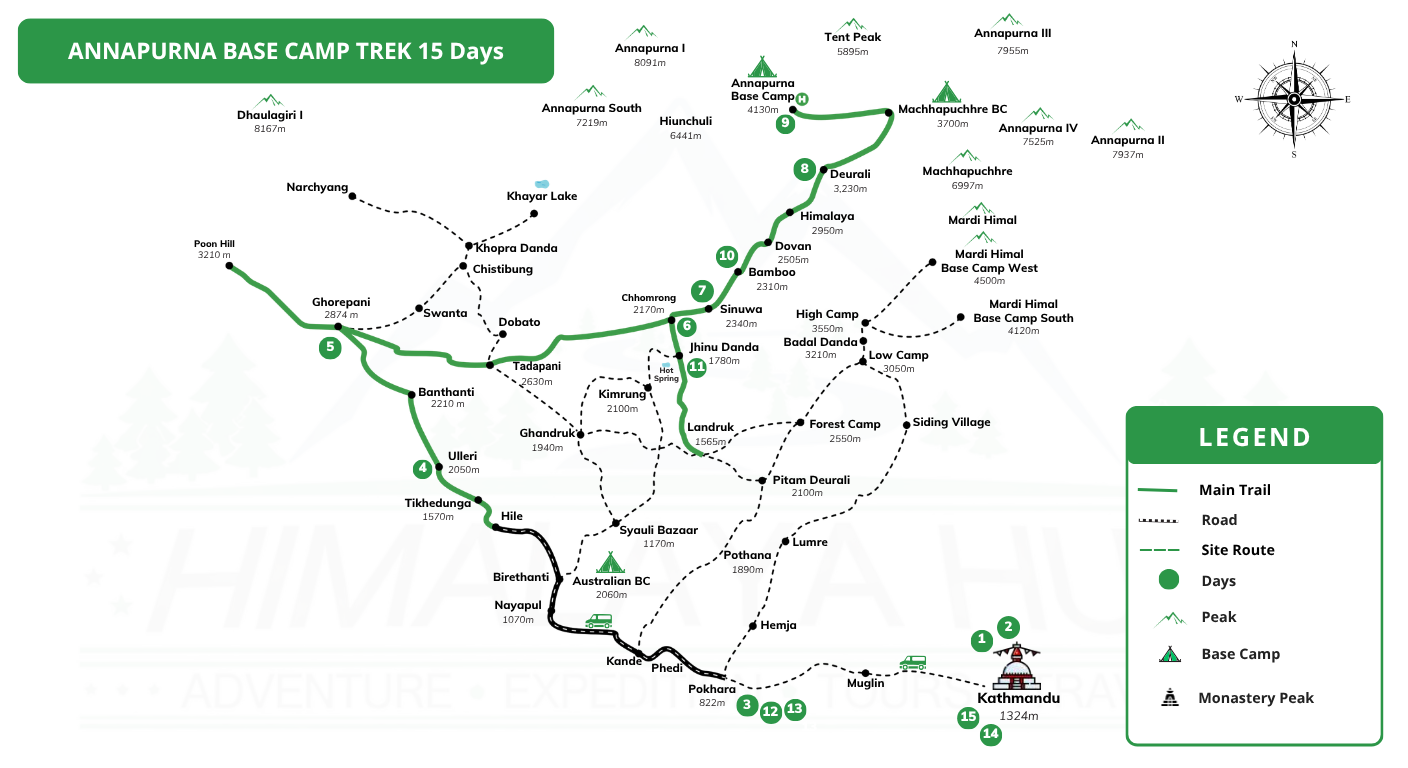
Kathmandu → Pokhara → Ulleri → Ghorepani → Poon Hill → Chhomrong→ Sinuwa → Deurali → ABC → Bamboo → Jhinu Danda → Motkyu → Pokhara → Kathmandu
This is not 15 days of trekking. It is a 15-day total trip, and it includes sightseeing days in Kathmandu and Pokhara, plus the Ghorepani and Poon Hill section before joining the same core trail toward ABC.
Actual trekking happens on 9 of the 15 days (Days 4 through 12). The rest are arrival, sightseeing, and drive days.
- Starting point: Nayapul, after a drive from Pokhara
- Highest altitude: 4,130 m at ABC (Poon Hill adds a side peak at 3,210 m)
- Trek days: 9 out of 15 total days
- Route style: Extended, includes Poon Hill and city sightseeing
5-Day vs 15-Day ABC Route Comparison
| Feature | 5-Day Route | 15-Day Route |
| Trip duration | 5 days | 15 days |
| Actual trekking days | 5 | 9 |
| Trek structure | Compressed | Extended |
| Poon Hill included | No | Yes |
| ABC included | Yes | Yes |
| Kathmandu sightseeing | No | Yes |
| Pokhara sightseeing | Limited | Yes, dedicated day |
| Daily walking hours | Higher on average | More evenly spread |
Neither route is better on paper. The 5-day route gets you to ABC faster but asks for more from your legs each day. The 15-day route spreads the same core trek across more time and adds Poon Hill and sightseeing around it.
Are you interested in planning a custom trip? Tell us your travel plans and we'll create a personalized itinerary
based on your budget, interests, and schedule.
How to Read the Annapurna Base Camp Trek Map
A route map for the ABC trek is not just a line on a page. It mixes driving sections, walking sections, and altitude change, often on the same day. Here is how to read it correctly.
Understanding the Trailhead
Both itineraries start from Pokhara (822 m), but the trekking starts at different points. The 5-day route drives to Siwai before trekking, while the 15-day route continues to Nayapul and then heads toward Ulleri.
Road Sections vs Trekking Sections
Always separate driving distance from walking distance. For example, the 5-day route includes driving and trekking on the same day, while Day 4 of the 15-day route covers about 41 km by road and 12 km on foot. A short walking distance can still take several hours if the trail is steep, so check both distance and walking time before judging the difficulty.
Reading Elevation on the Map
Altitude shows how demanding a day may feel. Gaining 800–900 m can make a short trek challenging, while walking 15 km on flatter ground may simply be a long day. For a better understanding of the route, always read distance, walking time, and elevation together.
Annapurna Base Camp Trek Distance and Walking Hours
Trekking distance is often reported differently between itineraries, because some count only the walking portion, while others include short village-to-village stretches that could be driven. The numbers below use trek-only distance, separated from any drive.
5-Day Day-by-Day Distance Breakdown
| Day | Route | Trek Distance | Drive Distance | Walking Time | Altitude |
| 1 | Pokhara → Siwai → Sinuwa | 10 km | 50 km | 5 hrs (+2 hrs drive) | 2,340 m |
| 2 | Sinuwa → Deurali | 11 km | 6 hrs | 3,230 m | |
| 3 | Deurali → ABC (via MBC) | 7.7 km | 6 hrs | 4,130 m | |
| 4 | ABC → Sinuwa | 19 km | 7 hrs | 2,340 m | |
| 5 | Sinuwa → Jhinu Danda → Pokhara | 12 km | 55 km | 4 hrs (+4 hrs drive) | 822 m |
15-Day Day-by-Day Distance Breakdown (Trekking Days Only)
| Day | Route | Trek Distance | Drive Distance | Walking Time | Altitude |
| 4 | Pokhara → Nayapul → Ulleri | 12 km | 41 km | 6 hrs (+1 hr drive) | 2,050 m |
| 5 | Ulleri → Ghorepani | 9 km | 5 hrs | 2,874 m | |
| 6 | Ghorepani → Poon Hill → Chhomrong | 13 km | 7 hrs | 2,560 m | |
| 7 | Chhomrong → Sinuwa | 11 km | 6 hrs | 2,340 m | |
| 8 | Sinuwa → Deurali | 14 km | 6 hrs | 3,230 m | |
| 9 | Deurali → ABC (via MBC) | 9 km | 5 hrs | 4,130 m | |
| 10 | ABC → Bamboo | 13 km | 6 hrs | 2,310 m | |
| 11 | Bamboo → Jhinu Danda | 10 km | 5 hrs | 1,780 m | |
| 12 | Jhinu Danda → Motkyu → Pokhara | 3 km | 60 km | 1 hr (+3 hrs drive) | 822 m |
Days 1, 2, 3, 13, 14, and 15 of the 15-day itinerary are arrival, sightseeing, or drive days, with no trekking.
Estimated Walking Hours Per Day
- Shortest trekking day: Day 12 of the 15-day route, at just 1 hour of walking before the drive back to Pokhara.
- Longest trekking day: Day 6 of the 15-day route (Ghorepani → Poon Hill → Chhomrong) and Day 4 of the 5-day route (ABC → Sinuwa), both at 7 hours.
- Typical range: Most trekking days fall between 5 and 6 hours of walking.
Terrain and altitude both affect these numbers more than distance alone. A 9 km day above 3,000 m, like Deurali to ABC, can take just as long as a 13 km day at lower elevation, because thinner air slows your pace and the trail gets steeper near the top.
Your own walking speed will also shift these numbers. Trekkers who stop often for photos, or who need more rest breaks at altitude, should expect the higher end of any time estimate.
Maximum Altitude Gain and Loss on the ABC Trek
This is where the two itineraries look most different, even though they end at the same destination.
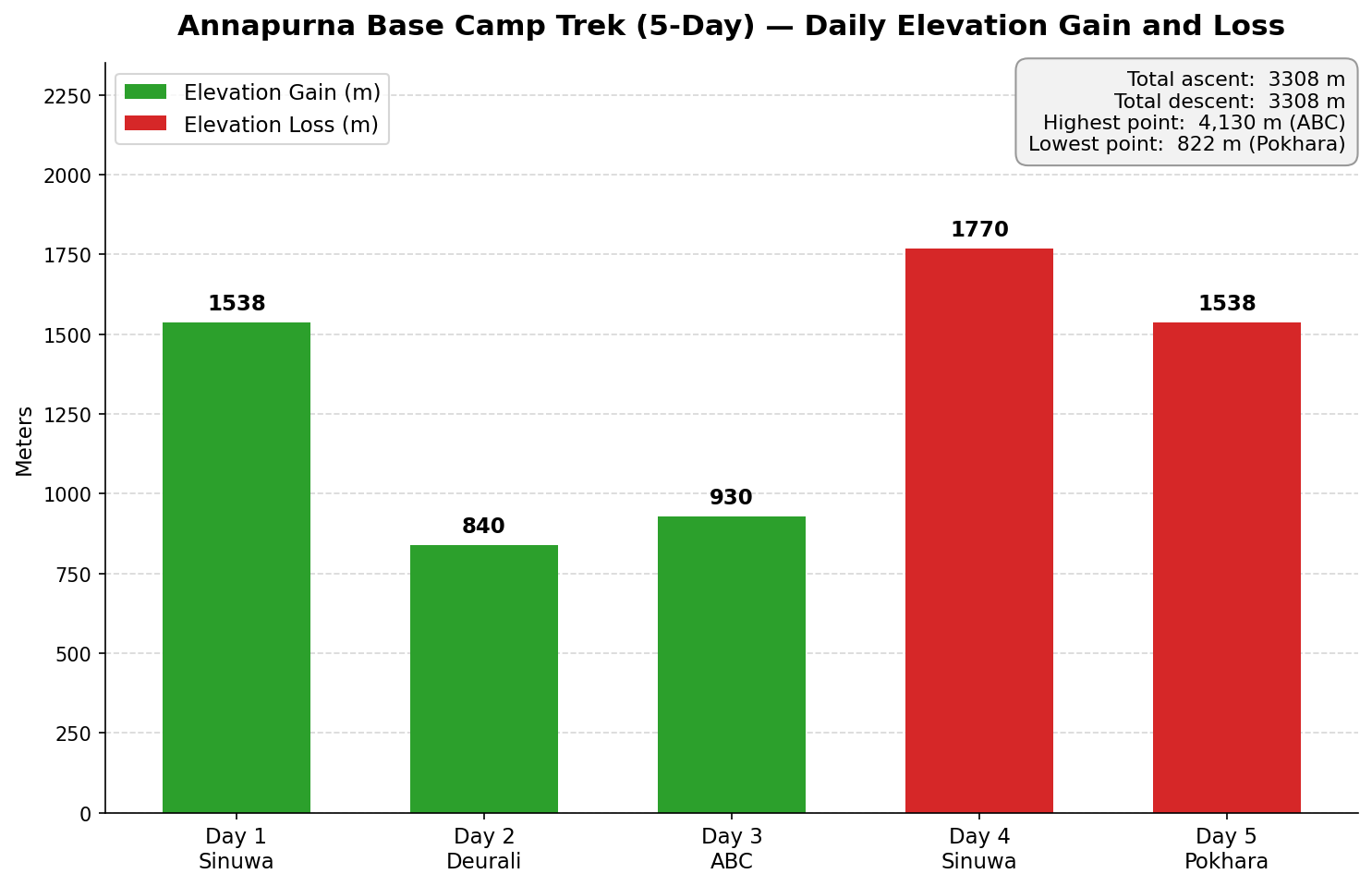
5-Day ABC Trek — Daily Elevation Gain and Loss
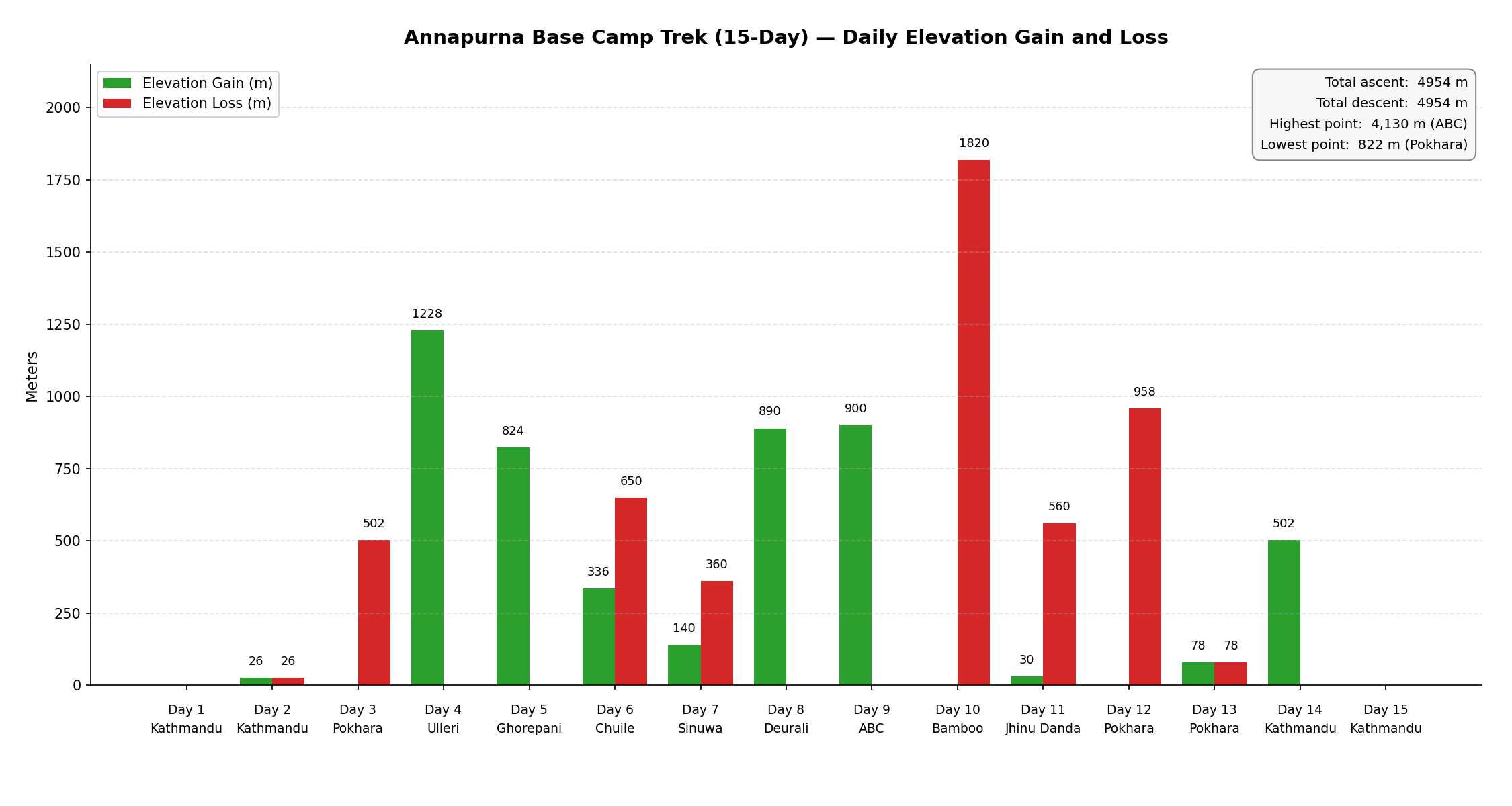
15-Day ABC Trek — Daily Elevation Gain and Loss
Daily Altitude Gain
The formula here is simple: ending altitude minus starting altitude.
| Day (15-day) | Route | Altitude Gain |
| Day 8 | Sinuwa → Deurali | +890 m |
| Day 9 | Deurali → ABC | +900 m |
| Day (5-day) | Route | Altitude Gain |
| Day 2 | Sinuwa → Deurali | +890 m |
| Day 3 | Deurali → ABC | +900 m |
Both itineraries show the exact same climbing pattern once they join the core trail: two back-to-back days of roughly 900 meters of gain each. This is the steepest part of the entire trek, no matter which route you follow.
Daily Altitude Loss
| Day (5-day) | Route | Altitude Loss |
| Day 4 | ABC → Sinuwa | −1,790 m |
| Day (15-day) | Route | Altitude Loss |
| Day 10 | ABC → Bamboo | −1,820 m |
| Day 11 | Bamboo → Jhinu Danda | −530 m |
| Day 12 | Jhinu Danda → Pokhara (mostly by drive) | −958 m |
Here is the real difference between the two routes. The 5-day itinerary drops almost 1,800 meters in a single day coming down from ABC. The 15-day itinerary spreads a similar total descent across three separate days.
For your knees and your overall fatigue, this matters. A single 1,800-meter descent day is hard on the joints, even though it is easier on your breathing than the climb up.
Highest Ascent and Descent Days
- Biggest single-day ascent: Deurali to ABC, at +900 m (identical in both itineraries)
- Biggest single-day descent: ABC to Sinuwa on the 5-day route, at −1,790 m
- Highest point on the trek: Annapurna Base Camp, 4,130 m
Annapurna Base Camp Trek Altitude Chart
Here is how altitude changes across the main stops on the route, from Pokhara to ABC and back down to Jhinu Danda.
5-Day Annapurna Base Camp Trek Altitude Chart
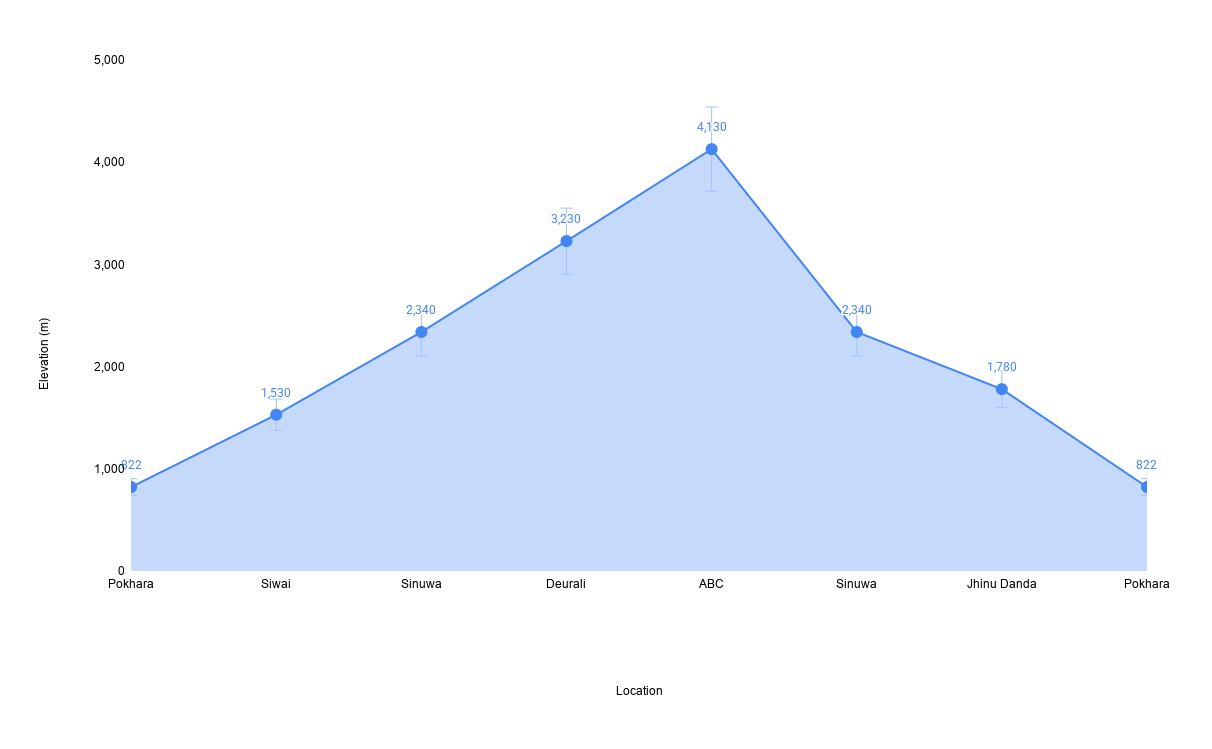
15-Day Annapurna Base Camp Trek Altitude Chart
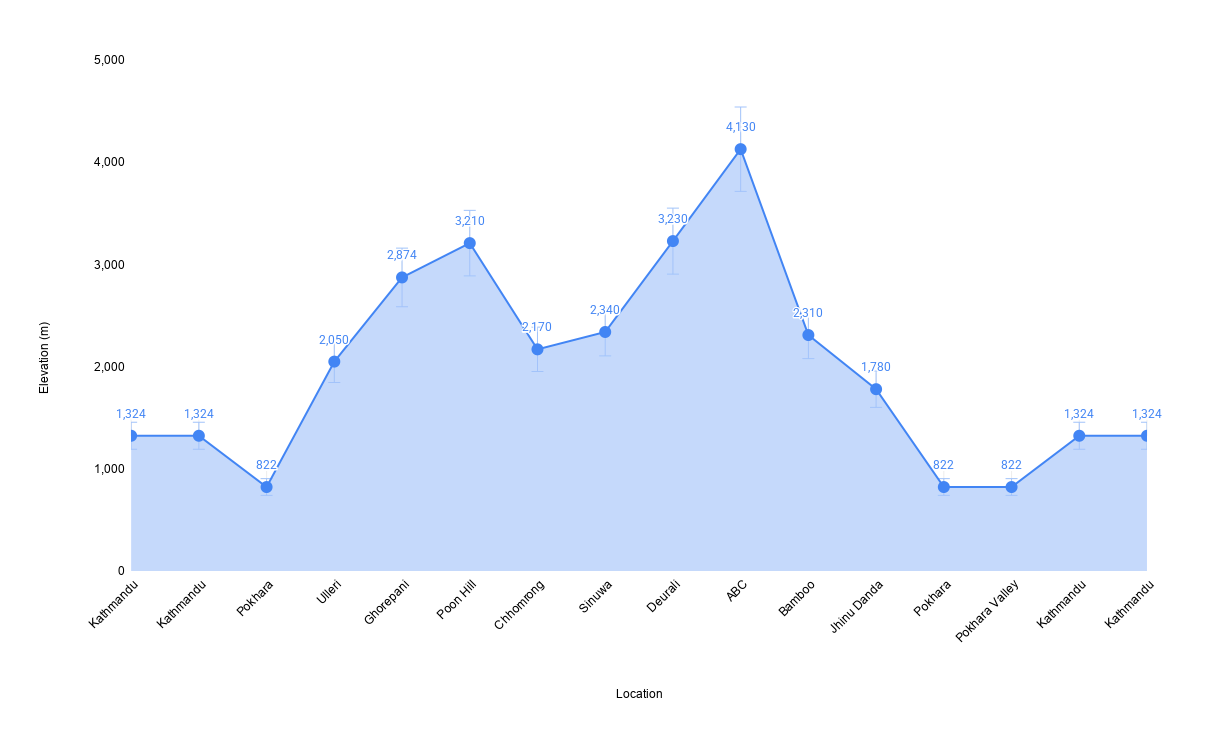
The altitude chart shows the elevation changes on both the 5-day and 15-day ABC routes. Both reach the same highest point, Annapurna Base Camp at 4,130 m, but the 15-day route spreads the climb over more days, while the 5-day route follows a faster schedule. Use the chart to compare daily altitude, plan your pace and rest, and prepare for changing conditions at higher elevations.
Route Variations on the Annapurna Base Camp Trek Map
ABC Trek via Ghorepani and Poon Hill
This is the route used in the 15-day itinerary. From Ulleri, the trail climbs to Ghorepani, then to the Poon Hill viewpoint at 3,210 meters for sunrise, before descending to Chhomrong and rejoining the main trail at Sinuwa.
Trekkers choose this variation for the sunrise views over Dhaulagiri, Annapurna South, and Machhapuchhre from Poon Hill. It adds trekking days but gives you one of the best panoramic viewpoints in the entire Annapurna region.
Direct Annapurna Base Camp Route
This is the route used in the 5-day itinerary. It skips Ghorepani and Poon Hill entirely, driving straight to Siwai and trekking through Chhomrong to Sinuwa on day one.
This route bypasses the Poon Hill sunrise viewpoint completely. In exchange, it saves several days of trekking. It suits trekkers who have already seen Poon Hill, or who are short on time.
Short 5-Day ABC Trek Route
Using the actual 5-day itinerary as the reference:
- Route: Pokhara → Siwai → Sinuwa → Deurali → ABC → Sinuwa → Jhinu Danda → Pokhara
- Total trek distance: About 60 km
- Highest altitude: 4,130 m
- Return route: Same trail back through Sinuwa, with a stop at Jhinu Danda for the hot springs before the drive to Pokhara
The compressed schedule works because it removes the Poon Hill side trip and uses vehicle transport to shorten the walking distance at both ends of the trek.
Return Route Options from ABC
| Return Route | What to Expect | Best For | Main Drawback |
| Walk Back the Same Way | Follow the same trail back through the familiar villages and teahouses. This is the standard return route for both 5-day and 15-day itineraries. | Trekkers who want a simple and predictable return | You see much of the same scenery again |
| Loop via Ghandruk | Take a different route through Ghandruk, a large Gurung village with beautiful mountain views. | Trekkers with extra time who want new scenery | Usually adds 1–2 extra days |
| Helicopter to Pokhara | Fly from ABC or MBC to Pokhara in about 20–30 minutes. Shared seats may cost around $300–$600 per person, depending on availability and current rates. | Trekkers with limited time or difficulty walking downhill | You miss Jhinu Danda, the hot springs, and lower trail villages |
Major Locations on the Annapurna Base Camp Trek
| Location | Altitude | Role on the Route |
| Pokhara | 822 m | Main gateway to the trek |
| Ulleri | 2,050 m | Early stop on the Poon Hill variation |
| Ghorepani | 2,874 m | Base for the Poon Hill sunrise hike |
| Poon Hill | 3,210 m | Sunrise viewpoint |
| Chhomrong | 2,560 m | Quiet overnight stop after Poon Hill |
| Chhomrong | 2,170 m | Major route junction, gateway village |
| Sinuwa | 2,340 m | Entry point to the Annapurna Sanctuary trail |
| Bamboo | 2,310 m | Forest stop before the climb to Deurali |
| Deurali | 3,230 m | Last major stop before MBC and ABC |
| MBC (Machhapuchhre Base Camp) | 3,700 m | Final stop before ABC |
| Annapurna Base Camp | 4,130 m | Trek destination |
| Jhinu Danda | 1,780 m | Lower stop, known for hot springs |
Where the Road Ends and Trekking Begins
- 5-day route: Road ends at Siwai. Trekking starts from there.
- 15-day route: Road ends at Nayapul. On the return, a short trekking stretch to Motkyu connects back to the road.
- Past these points, everything is on foot.
Important Trail Junctions
- Chhomrong is the most important junction on the whole map.
- Trails from Ghandruk, Ghorepani, and Jhinu Danda all meet here.
- From Chhomrong, every route continues the same way: toward Sinuwa and the Annapurna Sanctuary.
Teahouse Stops Along the Route
- Every overnight stop on both itineraries has teahouse accommodation.
- This includes Sinuwa, Deurali, ABC, Bamboo, Jhinu Danda, Ghorepani, and Chhomrong.
- Teahouses are simple guesthouses: a bed, hot meals, and basic comfort.
- Rooms get more basic the higher you climb.
Transport Access on the Return
- 5-day route: Vehicles reach the Jhinu Danda area.
- 15-day route: Vehicles reach Motkyu.
- From either point, you drive straight back to Pokhara – no need to walk the full return distance.
How GPS and Trail Maps Can Help
- A trail map (paper or app) confirms you’re on the right path.
- This matters most at busy junctions like Chhomrong or Bamboo, where multiple trails meet.
- A GPS app can track your altitude in real time.
- Real-time altitude readings help you pace yourself on the steepest days.
A quick planning note: as of 2026, the Annapurna Conservation Area Permit (ACAP) is required for every trekker on this route, and costs NPR 3,000 for foreign nationals. Guide requirements and additional permit rules have changed in recent years, so confirm the current requirements with your trekking agency before you travel.
Safety and Seasonal Conditions on the ABC Route
In winter, snow is common above Deurali, making the trail toward MBC more difficult. After heavy snowfall, some sections may need extra care or a small route change. During the monsoon, rain can make stone steps slippery and reduce visibility. Heavy rain may also increase landslide risk on lower sections.
The Deurali to ABC section can have avalanche risk in certain conditions, especially in spring. Guides check trail conditions and may change the route when needed. For altitude safety, walk at a steady pace, listen to your body above 3,000 m, and follow your guide’s advice on rest and pacing. Also, watch for sudden weather changes near MBC and ABC.
Our Expart Route Research
How We Compared the Routes
We compared both itineraries using walking distance, driving distance, walking hours, and altitude at each stop. This helped us understand the actual elevation gain and loss on each day.
What We Found
Both routes reach Annapurna Base Camp at 4,130 m. The main difference is the descent. The 5-day route packs almost 1,800 m of descent into one day, while the 15-day route spreads it over three days. Both routes have a similar climb from Sinuwa to ABC, gaining about 900 m on each of the two hardest days.
What the Map Does Not Show
A map cannot show everything. It does not tell you how 19 km feels after a long day, how steep the stone steps near Chhomrong are, or how the trail changes from dirt to loose rock above Deurali. Weather can also affect your pace. That is why the day-by-day details are important when planning your trek.
Which ABC Trek Route Is Right for You?
- 5-Day Route: Best for trekkers with limited time who want a direct ABC trek and can handle longer walking days. It skips Poon Hill and focuses on reaching ABC quickly.
- 15-Day Route: Best for trekkers with more time who want a slower pace, Poon Hill sunrise, and Kathmandu and Pokhara sightseeing.
Need a different plan? Himalaya Hub can customize your ABC trek based on your time, fitness, interests, and travel preferences. You can add extra trekking days, sightseeing, or other activities to create a trip that suits you. The price may be lower or higher depending on your requirements and the services you choose.
Conclusion
The Annapurna Base Camp trek map looks simple at first: a line from Pokhara to ABC and back. In practice, the route, distance, and altitude change quite a bit depending on which itinerary you follow.
The 5-day route gets you to ABC fast, with higher daily walking hours and a steep single-day descent. The 15-day route spreads the same core trek across more days and adds the Ghorepani and Poon Hill section along the way. Both share the same toughest climbing days – Sinuwa to Deurali to ABC, gaining close to 900 meters on each of the two hardest days.
Use the altitude chart and day-by-day tables in this guide to match a route to your own fitness, schedule, and interest in side trips like Poon Hill. With the numbers in front of you, you can plan a realistic trek instead of guessing from a flat map alone.
Frequently Asked Questions
What is the highest altitude on the Annapurna Base Camp Trek?
Annapurna Base Camp sits at 4,130 meters (13,550 feet), which is the highest point on the trek.
How long is the Annapurna Base Camp Trek?
The trek can range from a 5-day compressed itinerary to a 15-day trip that includes Kathmandu and Pokhara sightseeing, as well as the Ghorepani and Poon Hill section.
How many kilometers do you walk each day?
Daily trekking distance varies by itinerary. It can range from about 7.7 km on a steep climbing day to around 19 km on a longer descent day.
How many hours does it take to reach Annapurna Base Camp?
From Deurali, it takes about 5 to 6 hours to reach Annapurna Base Camp. The route passes through Machhapuchhre Base Camp (MBC) before reaching ABC.
Is there a 5-day Annapurna Base Camp Trek?
Yes. A 5-day Annapurna Base Camp Trek is possible. It uses vehicle transport to shorten the walking sections, skips the Poon Hill section, and reaches ABC before returning to Pokhara.
What is the difference between a 5-day and 15-day ABC trek?
The 5-day trek is a shorter, more direct route without Poon Hill. The 15-day itinerary includes Kathmandu and Pokhara sightseeing, the Ghorepani and Poon Hill section, and more time for the overall journey.
Does the ABC Trek go through Poon Hill?
Not always. It depends on the itinerary. The 15-day ABC route includes the Ghorepani and Poon Hill section, while the direct 5-day route does not.
Where does the biggest elevation gain happen on the ABC Trek?
The biggest elevation gains occur from Sinuwa to Deurali and Deurali to Annapurna Base Camp. Both sections gain close to 900 meters, making them some of the steepest parts of the trek.
0 Comment