






Tour Cost Comparison Table
Choosing the right trek can make a big difference to your total Nepal trekking budget. Short, road-accessible routes near Pokhara and Kathmandu are usually the most affordable because they need fewer trekking days and do not require a domestic flight. The prices below are based on Himalaya Hub Adventure trekking packages. Final costs can change depending on your group size, travel season, transport choice, itinerary, accommodation, permits, and package inclusions. Always confirm the latest price and what is included before booking.| Trek | Duration | Starting Price Per Person | Best Group Price Per Person | Cost Level | Why It Fits the Budget Guide | Best For |
| Short Poon Hill Trek | 3 days | Price should be confirmed | $189.99 for 13–15 trekkers | Lowest | Short trek, road access from Pokhara, teahouses, and no domestic flight | Beginners, families, weekend travelers |
| Dhampus Sarangkot Trek | 8 days | $550 for 2–5 trekkers | $410 for 12–18 trekkers | Low to moderate | Accessible from Pokhara, lower altitude, mountain viewpoints, and cultural villages | Easy-going travelers, mature travelers, short-holiday visitors |
| Mardi Himal Trek | 5 days | $560 | $330 for 11–15 trekkers | Low to moderate | Short Annapurna trek with road access from Pokhara and shared group savings | Adventure travelers, fit beginners, solo travelers joining a group |
| Annapurna Base Camp Trek | 5 days | $540 | $280 for 11–15 trekkers | Moderate | A fast, high-value Annapurna option, but more demanding and not among the absolute cheapest routes | Fit and experienced trekkers with limited time |
| Ghorepani Poon Hill Trek | 11 days on current package page | $650 for 2–5 trekkers | $510 for 12–18 trekkers | Moderate | A classic teahouse trek with road access and strong mountain views; shorter versions can reduce total cost | First-time trekkers, photographers, cultural travelers |
| Pikey Peak Trek | 7 days | $650 | $600 for 10–15 trekkers | Moderate | Road-based access from Kathmandu and Everest views without a Lukla flight | Experienced trekkers, quieter Everest-region experience |
| Helambu Trek | 9 days | $699 for 2–3 trekkers | $695 for 4–5 trekkers | Moderate | Close to Kathmandu, no domestic flight, lower-altitude trekking, culture and forest trails | Cultural travelers, mature travelers, nature lovers |
| Tamang Heritage Trek | 10 days | $760 for 2–5 trekkers | $650 for 12–18 trekkers | Moderate | Road transport from Kathmandu and village-based cultural trekking | Cultural travelers, volunteers, community-based travel |
| Langtang Valley Trek | 11 days | $930 for 2–5 trekkers | $790 for 12–18 trekkers | Moderate to high | No Lukla flight, but the itinerary is longer and reaches higher elevations | Nature lovers, bird lovers, trekkers wanting a longer route |
| Annapurna Sanctuary Trek | 10 days | Price should be confirmed | $530 for 10–15 trekkers | Moderate to high | A fuller Annapurna journey with more days, villages, forests, and base-camp scenery | Trekkers who want a slower Annapurna experience |
What Actually Makes a Trek Cheap in Nepal?
A cheap trek is not simply about choosing the lowest-priced rooms. Your total trekking cost includes several parts of the journey, such as permits, transport, guides, porters, meals, accommodation, equipment, and personal expenses. Understanding these costs before you book makes it easier to set a realistic budget, choose the right trekking package, and avoid unexpected expenses on the trail.Permits and Entry Fees
Permits are costs you cannot remove from your trekking budget. Depending on the route, you may need a conservation-area permit, national-park entry fee, TIMS card, or restricted area permit. For example, Nepal Tourism Board lists the Annapurna Conservation Area entry fee for foreign visitors at NPR 3,000. Langtang National Park and other protected areas also have separate entry charges. TIMS is another important cost. Nepal Tourism Board currently lists TIMS at NPR 2,000 for non-SAARC applicants and NPR 1,000 for SAARC applicants. Its route list includes Everest, Langtang, Manaslu, Poon Hill–ABC, Mardi Himal, Khopra, Annapurna Circuit, and other popular trails. Restricted areas cost much more. The Department of Immigration lists Upper Mustang and Upper Dolpo permits at USD 500 per person for the first 10 days, followed by USD 50 per additional day. This is why restricted-area treks are usually not included in lists of cheap trekking routes.Teahouse Accommodation
Teahouses are one reason trekking in Nepal can remain affordable. A basic room is usually simple, with beds, blankets, and shared or basic private facilities depending on the village. At lower elevations, rooms can be inexpensive. Prices often rise as you go higher because food, building supplies, and other goods must travel farther into the mountains. Food also becomes more expensive at higher altitude. A practical daily budget should include:- Breakfast
- Lunch
- Dinner
- Tea or coffee
- Drinking water
- Hot showers
- Device charging
- Wi-Fi where available
- Snacks and personal items
Guide and Porter Costs
Guide and porter services can affect your total cost more than small savings on meals or rooms. A guide adds a daily cost, but you may be able to share that cost when traveling in a small group. The same is true for porter services. For example, four trekkers sharing one guide can pay less per person than a solo traveler booking a private guide. Do not assume you can remove guide costs from every route. Nepal Tourism Board currently lists many popular trekking routes where travelers need a licensed guide and agency-issued TIMS card.Season Timing
The time of year can also affect your spending. Spring and autumn are popular because weather and mountain views are often better. However, demand is higher, and lodges may have less flexibility during busy periods. Winter can offer quieter trails and possible savings on lower-altitude routes. However, cold weather and snow can affect higher trails. Monsoon can also bring lower demand, but rain, clouds, muddy paths, leeches, and landslides can make some routes less enjoyable. The goal is not to choose the cheapest month at any cost. Choose the most affordable season that still gives you a safe and enjoyable trek.How to Trek Cheaply in Nepal
You do not need to remove every comfort to lower your trekking budget. Instead, focus on cutting costs that add little value to your experience.1. Choose a Road-Accessible Route
A road-accessible route can save a lot compared with a trek that needs domestic flights. This is one reason Poon Hill, Mardi Himal, Langtang, Helambu and Dhampus–Sarangkot are attractive for budget travelers.2. Travel With a Group
Group travel can reduce the cost of guides, porters, private vehicles, and other shared services. If you are traveling with friends, ask for a group rate instead of booking separate services. A small group can make your trip more affordable without making it feel crowded.3. Eat Local Food
Dal bhat is a trekking staple for a good reason. It is filling, easy to find, and often better value than buying several snacks or Western-style meals. You do not need to eat the same meal every day, but local food can help keep your daily spending under control.4. Keep Your Luggage Light
A lighter backpack may reduce your need for a porter. Still, do not leave behind important clothing, medication, water supplies, or safety equipment just to save money. Saving a small amount is not worth being unprepared for rain, cold, or changing weather.5. Compare What Is Included
Two trekking packages can show very different prices while offering almost the same itinerary. Before booking, ask whether the price includes:- Licensed guide
- Porter service
- Permits and TIMS
- Teahouse accommodation
- Meals
- Ground transport
- Airport transfers
- Trekking gear
- Insurance
- Tips and personal expenses
6. Book With a Local Operator
A local Nepal trekking company can arrange permits, guides, transport, accommodation, and route planning in one place. This also makes it easier to adjust the itinerary and avoid paying for services you do not need. A trusted local operator should always explain what is included and excluded before you book.How Much Money to Bring on a Trek in Nepal?
The amount of money you need depends on your trekking route, trip length, guide service, transport, meals, and personal spending. For a basic teahouse trek, plan around $25–$55 per person per day on the trail. This is a general planning range, not a fixed package price. You should also keep extra cash for:- Hot showers
- Wi-Fi and charging
- Tea, coffee, snacks, and soft drinks
- Tips for guides and porters
- Emergency transport changes
- Extra accommodation nights
- Personal shopping
- Gear replacement or rental
Which Trek Fits Your Travel Style?
There is no single best option for every traveler. The right trek depends on your time, budget, fitness, and the type of experience you want.Luxury and Mature Travelers
Choose Helambu or Langtang with comfortable accommodation, private transport, and a slower itinerary. You can still enjoy a budget-conscious trek without making the trip feel basic or rushed.Experienced Trekkers
Choose Khopra Danda or Pikey Peak. These routes offer a stronger sense of adventure, fewer crowds, and excellent mountain views without the high cost of more remote trekking regions.Solo Adventurers
A solo trip does not always mean a cheap trip. Guide and transport costs can be harder to share when you travel alone. Poon Hill and Mardi Himal are good options for solo travelers who want shorter routes. However, always confirm the current guide and TIMS requirements before your departure date.Adventure Tourists
Mardi Himal is a strong option for adventure travelers. It combines forest trails, ridge walking, high viewpoints, and a more remote feeling in a short itinerary.Expatriates and Volunteers
If you live in Kathmandu or Pokhara, you have a big advantage. You can choose short weekend routes without paying for long domestic transport. Dhampus–Sarangkot is from Pokhara.Local Youth and Professionals
Short weekend routes are ideal when you only have a few days away from work. Choose a trek near Kathmandu or Pokhara, keep transport simple, and travel with friends to share costs.Nature and Bird Lovers
Langtang is a good choice for travelers who enjoy forest ecosystems, Himalayan landscapes, wildlife, and birdlife. Nepal Tourism Board highlights the region’s wildlife, including migratory birds, deer, monkeys, Himalayan tahr, and pika.Cultural Travelers
Choose Helambu or the Tamang Heritage Trail. These routes offer more time in villages, where you can learn about traditional homes, local food, Buddhist culture, crafts, and everyday life.2026 Permit and Safety Update
This is the section every budget traveler should read carefully. There is a common belief that you can make any Nepal trek cheaper by going without a guide. That is not a safe assumption in 2026. Nepal Tourism Board’s current TIMS guidance lists several routes where trekkers must travel with a licensed trekking guide and obtain an agency-issued TIMS card. The list includes Everest Base Camp, Gokyo, Langtang, Tamang Heritage Trail, Manaslu, Annapurna Circuit, Poon Hill–ABC, Khopra, and Mardi Himal. TIMS is now issued electronically. After registration and payment, the agency provides an e-card with a QR code. The lesson for budget travelers is simple: Do not build your trekking budget around old “independent trekking” prices. Check the requirements for your exact route and include guide and permit costs before comparing trekking packages. Safety must also stay part of your budget. Nepal Tourism Board advises trekkers to use designated routes, carry basic safety equipment, and take altitude sickness seriously above 3,000 meters. Cheap trekking should mean smart spending, not skipping important safety needs.Essential Packing List for Budget Trekkers
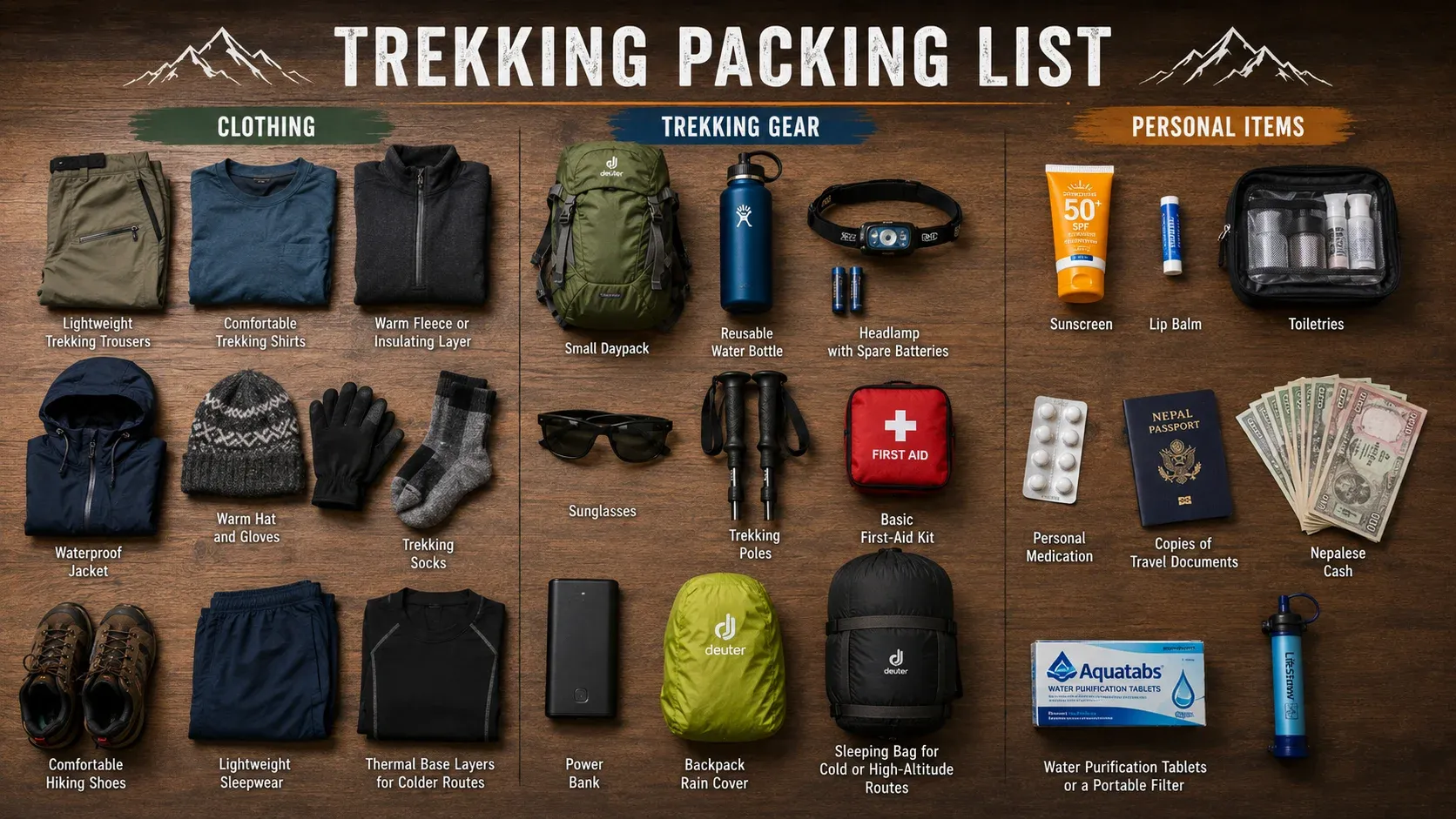 Packing well can help you save money and stay comfortable on the trail. You do not need expensive expedition gear for most budget-friendly treks in Nepal, but you do need practical clothing and basic safety items.
Clothing
Packing well can help you save money and stay comfortable on the trail. You do not need expensive expedition gear for most budget-friendly treks in Nepal, but you do need practical clothing and basic safety items.
Clothing
- Lightweight trekking trousers
- Comfortable trekking shirts
- Warm fleece or insulating layer
- Waterproof jacket
- Warm hat and gloves
- Trekking socks
- Comfortable hiking shoes
- Lightweight sleepwear
- Thermal base layers for colder routes
- Small daypack
- Reusable water bottle
- Headlamp with spare batteries
- Sunglasses
- Trekking poles
- Basic first-aid kit
- Power bank
- Backpack rain cover
- Sleeping bag for cold or high-altitude routes
- Sunscreen
- Lip balm
- Toiletries
- Personal medication
- Copies of travel documents
- Nepalese cash
- Water purification tablets or a portable filter
Packing Tips for Budget Trekkers
Do not buy every piece of trekking equipment before you know what you need. For short routes such as Dhampus–Sarangkot, and Poon Hill, you can pack light and avoid unnecessary purchases. For longer routes such as Langtang Valley, Khopra Danda, and Pikey Peak, prepare for colder temperatures and fast-changing mountain weather. Some trekking gear can be rented in Kathmandu or Pokhara. Ask your trekking operator what is included in your package and what you need to bring yourself. The goal is to pack light, useful, and practical while avoiding expensive purchases on the trail.Why Book a Budget Trek With Himalaya Hub Adventure?
A budget trek should be affordable, well planned, and enjoyable, not stressful. With Himalaya Hub Adventure, you get trusted local support that helps every dollar go further in the Himalayas. Tell the team your travel dates, fitness level, interests, travel style, and budget, and they will create a personalized trekking itinerary around your plan. You can choose a shorter route, adjust trekking days, join a group, or select the accommodation and support level that suits you. With 15+ years of experience, 50+ trekking guides and Sherpas, and certified local guides, Himalaya Hub Adventure offers reliable support from planning to the trail. The company is licensed by the Government of Nepal, an official TAAN member, and a recipient of the Tripadvisor Traveller’s Choice Award 2026. Whether you choose Poon Hill, Mardi Himal, Langtang, Helambu, or another route, the team helps you compare real costs before booking. Their service is backed by 1,092+ Tripadvisor reviews, 440+ Google reviews, and 1,000+ Trustpilot reviews.See What people are Saying About Us
Reviews

Shyama Kishore Gopalkaje


We just did the Manakamana temple, Pokhara, Ghandruk-Tadapani- Ghorepani -Tatopani trek + Muktinath with our Guide Ramit.
Himalaya Hub Adventure executive director Ramesh gave us all the necessary in…
Himalaya Hub Adventure executive director Ramesh gave us all the necessary in…
We just did the Manakamana temple, Pokhara, Ghandruk-Tadapani- Ghorepani -Tatopani trek + Muktinath with our Guide Ramit.
Himalaya Hub Adventure executive director Ramesh gave us all the necessary information to make our holiday really special and memorable. He attended to all our needs and gave a highly competitive quote. He provided us excellent vehicles and drivers and guide.
We set out from Kathmandu by road and visited Manakamana temple on the way to Pokhara. After a day of sightseeing in Pokhara including watching sunrise from Sarangkot viewpoint, we took next day early morning public bus to Ghandruk from where started our trek towards Tadapani . It is an ancient trade route and gives really memorable and special experiences but unfortunately we had continuous rain from the moment we started the trekking. Due to the clouds we missed the beautiful views of Himalayas which this trekking route is really famous for. We also spent some tense time in Tatopani due to the landslides along Kali Gandaki river where our guide took some excellent decisions to keep us safe.
Overall it was a great experience.
Ramit is a very good guide – very caring, knowledgeable, and always making sure I was safe and comfortable. He managed everything perfectly from hotels to food to permits. The only downside was the weather. Because of heavy rain, we couldn't see the good views from Ghorepani/Poon Hill and the trail became quite slippery and dangerous in some parts. But that's nature, nothing anyone can control, and he handled it very professionally and kept me safe. He took excellent decisions when faced with challenges posed by extreme weather conditions such as choosing a hotel accommodation at higher ground to keep us in safety in case of a flood and landslide. He sought required information for taking decisions regarding our trekking progress in difficult weather. He tested the path for safe crossing to minimise the risks that we were exposed to. He listened to our special needs and requirements and tried his best to meet with them such as ensuite accommodation, hot water, vegetarian food etc. His choice of teahouses and hotels were excellent.
Highly recommend Himalaya Hub Adventures for Nepal holiday packages.
Highly recommend Ramit Surkheti for anyone planning to trek in Nepal.
Himalaya Hub Adventure executive director Ramesh gave us all the necessary information to make our holiday really special and memorable. He attended to all our needs and gave a highly competitive quote. He provided us excellent vehicles and drivers and guide.
We set out from Kathmandu by road and visited Manakamana temple on the way to Pokhara. After a day of sightseeing in Pokhara including watching sunrise from Sarangkot viewpoint, we took next day early morning public bus to Ghandruk from where started our trek towards Tadapani . It is an ancient trade route and gives really memorable and special experiences but unfortunately we had continuous rain from the moment we started the trekking. Due to the clouds we missed the beautiful views of Himalayas which this trekking route is really famous for. We also spent some tense time in Tatopani due to the landslides along Kali Gandaki river where our guide took some excellent decisions to keep us safe.
Overall it was a great experience.
Ramit is a very good guide – very caring, knowledgeable, and always making sure I was safe and comfortable. He managed everything perfectly from hotels to food to permits. The only downside was the weather. Because of heavy rain, we couldn't see the good views from Ghorepani/Poon Hill and the trail became quite slippery and dangerous in some parts. But that's nature, nothing anyone can control, and he handled it very professionally and kept me safe. He took excellent decisions when faced with challenges posed by extreme weather conditions such as choosing a hotel accommodation at higher ground to keep us in safety in case of a flood and landslide. He sought required information for taking decisions regarding our trekking progress in difficult weather. He tested the path for safe crossing to minimise the risks that we were exposed to. He listened to our special needs and requirements and tried his best to meet with them such as ensuite accommodation, hot water, vegetarian food etc. His choice of teahouses and hotels were excellent.
Highly recommend Himalaya Hub Adventures for Nepal holiday packages.
Highly recommend Ramit Surkheti for anyone planning to trek in Nepal.

Jeroen Kruft
Took a wonderful 4-day, 3-day tour in the surroundings of Kathmandu valley. The kind and knowledgeable guide Prem took us to Chisapani and Nagarkot, and arranged for good to excellent accommodations, …
Took a wonderful 4-day, 3-day tour in the surroundings of Kathmandu valley. The kind and knowledgeable guide Prem took us to Chisapani and Nagarkot, and arranged for good to excellent accommodations, excellent food, all included, at an affordable price.
This tour is in the Himalayan hills and is relatively easy (ave. 6 hrs trekking per day). Lovely village sceneries, see Nepali agriculture, walks through the jungle and stiff climbs sometimes. 💪🏽
Communication with Puru of Himalaya Hub Adventures to book the tour and get all the details was very smooth.
Highly recommended!
This tour is in the Himalayan hills and is relatively easy (ave. 6 hrs trekking per day). Lovely village sceneries, see Nepali agriculture, walks through the jungle and stiff climbs sometimes. 💪🏽
Communication with Puru of Himalaya Hub Adventures to book the tour and get all the details was very smooth.
Highly recommended!

Theresa Frasch
A well organized Mardi Himal trek was expected from Himalaya Hub. And they delivered.
From the morning pickup, bus transport, and hotel in Pokhara, through each day of trekking and our return to Kath…
From the morning pickup, bus transport, and hotel in Pokhara, through each day of trekking and our return to Kath…
A well organized Mardi Himal trek was expected from Himalaya Hub. And they delivered.
From the morning pickup, bus transport, and hotel in Pokhara, through each day of trekking and our return to Kathmandu, everything was taken care of seemlessly.
Their well trained guide/porter Karan made every effort to see that we had a great experience.
This was our second time using Himalaya Hub, we had an excellent Everest Base Camp trek with them in 2018, so naturally they were our first choice when we arrived in Kathmandu this year.
From the morning pickup, bus transport, and hotel in Pokhara, through each day of trekking and our return to Kathmandu, everything was taken care of seemlessly.
Their well trained guide/porter Karan made every effort to see that we had a great experience.
This was our second time using Himalaya Hub, we had an excellent Everest Base Camp trek with them in 2018, so naturally they were our first choice when we arrived in Kathmandu this year.

Abhishek Bharti

Ida Pagaard Sommer
We warmly recommend Himalaya hub as a trekking agency. A great thanks to our guide Surya, for guiding us safely through Manaslu Circuit. He went above and beyond for making our trek an amazing adventu…
We warmly recommend Himalaya hub as a trekking agency. A great thanks to our guide Surya, for guiding us safely through Manaslu Circuit. He went above and beyond for making our trek an amazing adventure. We also send our biggest thanks to our sweet and strong porter Naran.
Kind thanks from Julie and Ida, we will always remember🙏🏼
Kind thanks from Julie and Ida, we will always remember🙏🏼

Ariel Weinshall
Great experience guide is very reliable. He planed the timing perfectly and cared for us when we were sick. He is trainer paramedics I recommended to book with him

Jeronimo Pedroza
Everyone was amazing, very friendly and chatty

Birkha Thakulla

Raghab Sirmal

Charlie Flockart
Amazing experience! Our guide Prem was really good. He ensured we had everything we needed at every step of the way. Prem was also very knowledgeable and informative. The company was very clear and in…
Amazing experience! Our guide Prem was really good. He ensured we had everything we needed at every step of the way. Prem was also very knowledgeable and informative. The company was very clear and informative and helped us pick the best hike for our circumstance. I would highly recommend!

Elliott Nicoll
Had a great 5 days during my hike to ABC. The company was great and the whole trip was completely hassle free. From Kathmandu to ABC, and back we were accompanied by our awesome guide Prem. He was the…
Had a great 5 days during my hike to ABC. The company was great and the whole trip was completely hassle free. From Kathmandu to ABC, and back we were accompanied by our awesome guide Prem. He was the man, helped us with anything we needed; …

Ilona van Birgelen
thanks to Prabin and Bishnu we had an experience to remember forever! this was my first multi day trek (to ABC), and they made us feel so safe, capable, motivated us and were so kind people we became …
thanks to Prabin and Bishnu we had an experience to remember forever! this was my first multi day trek (to ABC), and they made us feel so safe, capable, motivated us and were so kind people we became very good friends fast! i could not wish …

Simone Versteegt
We have had an amazing Manaslu Circuit Trek with our guide Rupesh. The views were fantastic and Rupesh arranged everything perfectly. He was really aware of everyone, was funny and could tell a lot ab…
We have had an amazing Manaslu Circuit Trek with our guide Rupesh. The views were fantastic and Rupesh arranged everything perfectly. He was really aware of everyone, was funny and could tell a lot about the area. We would definitely recommend going with him!!

Оксанка Алехина
I would like to thank our guide Ramit for the incredible support and guidance during our trek to Everest Base Camp. It was not just a trek, but a true adventure. Ramit knew the route extremely well an…
I would like to thank our guide Ramit for the incredible support and guidance during our trek to Everest Base Camp. It was not just a trek, but a true adventure. Ramit knew the route extremely well and was always ready to help. I especially …

Jack Napier-Hill
We had the most incredible experience with Himalayan Hub Adventure from start to finish. Everything was organised so smoothly, and the entire trip exceeded our expectations. …

Colm Scully
Did the ABC trek with Shiva as a guide. Great guid, great experience. Everything was taken care of. Would recommend.

KL Buckle
Amazing Trek, our Guide Bishal was great, veeeery chill guy. Enjoyed perfect conditions with a very nice group.

Jason Aaron Chapman
Annapurna Circuit Trek with our guide Ramit was honestly one of the best experiences I’ve ever had! From start to finish, Ramit was the perfect guide — always there to answer questions, help when need…
Annapurna Circuit Trek with our guide Ramit was honestly one of the best experiences I’ve ever had! From start to finish, Ramit was the perfect guide — always there to answer questions, help when needed, but also giving us space to enjoy …

陳叙
Our tour guide is nice and professional. He explains all the details and information we need to know during the trekking.

Suk Nam
We had an amazing experience with this company. We arrived in Kathmandu with almost no plan, and they helped us sort out everything quickly at a really reasonable price. …

Emmy
Did the Anapurna Circuit and had a wonderful experience. Our guide Ramit was the best choice for the trip- he had a lovely energy and made sure all was perfectly organised aswell as flexible 🙌🏻 on top…
Did the Anapurna Circuit and had a wonderful experience. Our guide Ramit was the best choice for the trip- he had a lovely energy and made sure all was perfectly organised aswell as flexible 🙌🏻 on top of that you can tell he has great …

Wesley Kool
I did the Mardi Himal trekking with Rupesh in March, I had the greatest time and everything was in good order!

Dinesh Shakya

Ivana Bobadilla
Biru is the best guide you could ever have!! I did ABC trek 5 days and the views were insane! The company himalaya hub was very responsive and offered a lot of help to assist me in planning my trip. I…
Biru is the best guide you could ever have!! I did ABC trek 5 days and the views were insane! The company himalaya hub was very responsive and offered a lot of help to assist me in planning my trip. I compared with many other companies and they offer the best price. They even offered a free pickup from the airport which made my arrival so much better. I highly recommend my guide Biru who taught me so much about the nepalese culture and who supported me throughout the whole trek. Thank you🫶🏼

Tom Purnell
We had an incredible experience with Himalaya Hub Adventure. The 12-day Manaslu Circuit trek was excellent value, very well organised, and exceeded expectations.
A huge thank you to our guides, Rosha…
A huge thank you to our guides, Rosha…
We had an incredible experience with Himalaya Hub Adventure. The 12-day Manaslu Circuit trek was excellent value, very well organised, and exceeded expectations.
A huge thank you to our guides, Roshan and Bipin, who were outstanding—professional, knowledgeable, kind, and went above and beyond to make sure everyone felt safe, comfortable, and well looked after. Roshan was especially organised at the guesthouses and meal times, quickly getting us settled in after each day’s trekking and clearly explaining the plan for the next day.
I also have a severe nut allergy, which Roshan managed with great care throughout the trek, something I really appreciated.
If you’re considering trekking in Nepal, I couldn’t recommend Himalaya Hub Adventure highly enough.
A huge thank you to our guides, Roshan and Bipin, who were outstanding—professional, knowledgeable, kind, and went above and beyond to make sure everyone felt safe, comfortable, and well looked after. Roshan was especially organised at the guesthouses and meal times, quickly getting us settled in after each day’s trekking and clearly explaining the plan for the next day.
I also have a severe nut allergy, which Roshan managed with great care throughout the trek, something I really appreciated.
If you’re considering trekking in Nepal, I couldn’t recommend Himalaya Hub Adventure highly enough.

Gabriela Gallner
My husband and I went on a 4 day trek with Biru (ab absolute superstar!!!!). Originally we signed up for the Mohare trek but 3 days in we decided to extend and add an additional 3 days! Biru was amazi…
My husband and I went on a 4 day trek with Biru (ab absolute superstar!!!!). Originally we signed up for the Mohare trek but 3 days in we decided to extend and add an additional 3 days! Biru was amazing and provided us with numerous options …

Matjeu van Kasteren
Had a amazing Annapurna Track with my friends and guide Krishna and porters Bipin & Purna. They where super helpful.

Bart-Jan
Annapurna trek 9 days with Krishna as guide and Bipin and Purna as porters!

Lancelot Duurham
Had a good experience with the Annapurna circuit with Krishna as our guide and Binpin and Purna as assistant guides. Would recommend!

Summer Phillips
We just finished a 2 week private Annapurna circuit trek with guide Ram and porter Roshan. It was amazing! They were both so kind and fun! From the minute we got picked up we were treated so well, alw…
We just finished a 2 week private Annapurna circuit trek with guide Ram and porter Roshan. It was amazing! They were both so kind and fun! From the minute we got picked up we were treated so well, always given lots of info about the trek / …

Abid A

Our 7-day tour with Ramit was an incredible experience, and we honestly couldn’t have asked for a better guide. From the very beginning, he went above and beyond to make sure we had the best possible …
Our 7-day tour with Ramit was an incredible experience, and we honestly couldn’t have asked for a better guide. From the very beginning, he went above and beyond to make sure we had the best possible trip. It was clear that he genuinely cared about us and wanted everyone to have an amazing experience.What really stood out was how Ramit handled the unexpected. One of our group members got injured during the trip, and Ramit immediately stepped up, carried his bag, and made last-minute adjustments to our plans to make sure everything went as smoothly as possible. He never made us feel like we were inconveniencing him. Instead, he did whatever was needed to help our group and make sure everyone was taken care of. That kind of kindness and dedication says a lot about the person he is.Throughout the entire 7 days, Ramit consistently went the extra mile, not because he had to, but because he genuinely wanted us to have the best experience possible. By the end of the trip, he felt like more than just our guide; he was someone we were truly grateful to have shared the journey with.If you’re planning a trip in Nepal, I couldn’t recommend Ramit enough. He made an already amazing adventure even more memorable, and we’ll always appreciate the effort and care he put into making our trip special. Thank you, Ramit!
Max D
Had a great time with Kaushal hiking from Mardi Himal and then onto ABC, views were amazing and the guide was even better.
Ida S
We warmly recommend Himalaya hub as a trekking agency. A great thanks to our guide Surya, for guiding us safely through Manaslu Circuit. He went above and beyond for making our trek an amazing adventu…
We warmly recommend Himalaya hub as a trekking agency. A great thanks to our guide Surya, for guiding us safely through Manaslu Circuit. He went above and beyond for making our trek an amazing adventure. We also send our biggest thanks to our sweet and strong porter Naran. Kind thanks from Julie and Ida, we will always remember🙏🏼
Zina A
Biru was the best guide! If you’re considering going on a trek – definitely go with Biru from this company. He made the whole experience from start to finish! It was an instant friendly vibe once meet…
Biru was the best guide! If you’re considering going on a trek – definitely go with Biru from this company. He made the whole experience from start to finish! It was an instant friendly vibe once meeting him in the hostel before the trek, he helped us organise items we needed for the trek and took care of all of it. He really went out his way for the whole 6 day kohpre ridge route. This man made sure I did not get a single leach after I was terrified of them, stopping every so often to check me and remove them. He carried me across the rivers caused by landslides as the jumps were too big for me. Everywhere we went he was talking to locals and helping everyone, it was very obvious biru was a much loved guide throughout all the guest houses. There is nothing this man wouldn’t do! He really went out his way even helping locals on the trek with their luggage. A very kind hearted man. If anyone needs a guide and is going with this company I can only recommend Biru!! 5/5 stars!
Jeroen K
Took a wonderful 4-day, 3-day tour in the surroundings of Kathmandu valley. The kind and knowledgeable guide Prem took us to Chisapani and Nagarkot, and arranged for good to excellent accommodations, …
Took a wonderful 4-day, 3-day tour in the surroundings of Kathmandu valley. The kind and knowledgeable guide Prem took us to Chisapani and Nagarkot, and arranged for good to excellent accommodations, excellent food, all included, at an affordable price. This tour is in the Himalayan hills and is relatively easy (ave. 6 hrs trekking per day). Lovely village sceneries, see Nepali agriculture, walks through the jungle and stiff climbs sometimes. 💪🏽Communication with Puru of Himalaya Hub Adventures to book the tour and get all the details was very smooth. Highly recommended!
Felix B
We booked the Manaslu Circuit with Himalaya Hub at the beginning of 2026 on a friend's recommendation and hiked it over 13 days in October. Sitting at home in Germany, we honestly thought it was too g…
We booked the Manaslu Circuit with Himalaya Hub at the beginning of 2026 on a friend's recommendation and hiked it over 13 days in October. Sitting at home in Germany, we honestly thought it was too good to be true at first: our contact on WhatsApp, Prakash, was incredibly friendly, and whatever we asked or requested, he told us he could make it happen, all at a very fair price compared to other offers.We didn't have much choice but to trust him, and although we were still a little skeptical because of how accommodating he was, we stuck with it. But when Prakash kept us updated several times about the floods, when we saw videos of him helping out on the ground himself, and when he was available every single day before our trip to let us know whether we could go ahead, we knew we were in good hands.When we arrived in Kathmandu, we visited his office and were welcomed very warmly. We planned everything for the next two weeks together, and once again Himalaya Hub was wonderfully flexible and accommodating with our last-minute requests, such as a jeep transfer, storing the rest of our equipment, and a free transfer to Pokhara afterwards.Other agencies had already tried to win us over at the airport with special offers, but after all the care and attention Prakash had shown us before the trip, we had no intention of switching, especially since the price was more than fair compared to other agencies (something we can confidently confirm after the trek and talking to other hikers).The next morning we set off with our guide toward the start of the trek. We rarely write reviews, but we really wanted to give a wholehearted recommendation here, above all because of our guide, Suraj. From day one, Suraj was extremely polite, kind, positive, helpful, and considerate. He answered my countless questions with amazing knowledge and was simply wonderful company.The trek was stunning and we are grateful for everything we got to experience, but Suraj made this journey truly special. Every evening he arranged a very good lodge and room for us, gave us small gifts that will be beautiful keepsakes, and made the trip even better with lots of little gestures. What we loved most, though, were our evenings together playing cards, even if he won most of the time.We can't recommend Suraj highly enough. He is an incredibly good guide, and you can tell he does this job with genuine passion and real expertise. But above all, he is a wonderful person!We are very grateful to Himalaya Hub for making this amazing trip possible for us at a not-so-easy time, and we're already looking forward to coming back!Thank you so much!Felix

Юлия
Manaslu is not just a trek. It's 12 days that tore my heart apart and put it back together. And a huge part of that magic was our guide Biru!!! I still don't understand how a person can be so calm, so…
Manaslu is not just a trek. It's 12 days that tore my heart apart and put it back together. And a huge part of that magic was our guide Biru!!! I still don't understand how a person can be so calm, so reliable, and so inspiring at the same time. When things got tough and the altitude was draining my strength, he was right there: checking on how we felt, encouraging us, and always finding the words that made you want to keep going. He didn't just "lead us along the route" — he genuinely took care of us and made sure every day was awesome. He knows the region inside out and told us so many interesting things about the culture, religion, and mountains. He answered any question we had. I felt not like a tourist, but like part of something big and real.Biru, Thank you for the safety, the care, the humanity, and for making this trek not just a hike, but one of the greatest memories of my life. I recommend him with all my heart! Biru ❤️!!!
Violetta C
An unforgettable experience on the Manaslu track! ✨ My heartfelt thanks to everyone who made this journey so special, and especially to our incredible guide, Beru, for the professionalism, kindness, p…
An unforgettable experience on the Manaslu track! ✨ My heartfelt thanks to everyone who made this journey so special, and especially to our incredible guide, Beru, for the professionalism, kindness, patience, and genuine care throughout the experience. Your knowledge, warm energy, and attention to every detail made everything truly memorable. Thank you for sharing this beautiful adventure with us, for your support, and for making us feel safe, welcome, and inspired. I’m deeply grateful for every moment and will cherish these memories for a long time. Highly recommended — an amazing experience with an exceptional guide! ❤️🙏Violetta 18.10.2026
Татьяна Ш
The Manaslu Trek is truly one of the most spectacular adventures in the Himalayas, combining an incredible variety of landscapes that are hard to find along a single route: from humid tropical jungles…
The Manaslu Trek is truly one of the most spectacular adventures in the Himalayas, combining an incredible variety of landscapes that are hard to find along a single route: from humid tropical jungles on the lower slopes to eternal glaciers and high mountain ranges, where harsh northern beauty reigns. And people like the guide make this journey not just beautiful, but also safe, especially on challenging sections like the descent from Lark La Pass.During all the journey Biru supported us, especially on the way down Lark La Place: I was wery afraid of falling and he helped me through this fear. It is so good, that in such moments, the help and support of local guides is not limited to physical assistance alone — they become not just guides, but reliable companions who share their rich experience, amazing stories about the region’s secrets, the traditions of local residents, and the secrets of the Himalayan nature itself. Years spent in these mountains allow them to feel every trail, anticipate the slightest risks, and be right there when you need support most of all — whether it’s a steep descent from a high pass or just lunch in a small mountain village, where they will help us navigate unfamiliar customs or share warmth and the history of the local people.I want thank Biru from all of my heart for this beautiful journey and I believe that we will meet each other again in different Himalayas treks ❤️
mary m
I had a great trek doing to Manaslu Circuit with Devendra as my guide and Resham as my porter. They were both very attentive, approachable and friendly. Devendra was from the Manaslu region and shared…
I had a great trek doing to Manaslu Circuit with Devendra as my guide and Resham as my porter. They were both very attentive, approachable and friendly. Devendra was from the Manaslu region and shared lots of local knowledge a long the trek. I would highly recommend booking a trek with Devendra as your guide! The trek itself was very beautiful too and the food and tea houses along the way were brilliant.
PrettyisPretty
We have really good time in poon hill with tour guide Ram and his assistant. Everything’s well plan, but keep things flexible. And he is very helpful and supportive during the trekking. I will definit…
We have really good time in poon hill with tour guide Ram and his assistant. Everything’s well plan, but keep things flexible. And he is very helpful and supportive during the trekking. I will definitely recommend Ram as your tour guide!!!
Zoe M
The most fabulous experience! I was recommended the Langtang Valley trek to fit with the amount of time I had, and it was beautiful. My guide Suraj was brilliant as well, super friendly, super knowled…
The most fabulous experience! I was recommended the Langtang Valley trek to fit with the amount of time I had, and it was beautiful. My guide Suraj was brilliant as well, super friendly, super knowledgeable about the landscape and plants and culture (and importantly, the food😂), and basically a lovely person to spend the week with. Everything was organised really smoothly and quickly., absolutely no notes. Would recommend to anyone and everyone.

Joep S
I did an expedition to Mera Peak in July. I really enjoyed every second of this. A very nice and good English speaking guide. Everything was perfectly arranged.

Shivang R
I had the most beautiful time trekking in the Tsum Valley and the Manaslu Circuit earlier in the month of May.I was joined by Suraj Bhai as our guide and Saroj Dai as our porter, along with amazing fo…
I had the most beautiful time trekking in the Tsum Valley and the Manaslu Circuit earlier in the month of May.I was joined by Suraj Bhai as our guide and Saroj Dai as our porter, along with amazing folks from France and Canada. Suraj is an amazing guide, full of life, wisdom and humility. He was there for us, caring and attentive, deeply observant and kind, all the time. If one of us fell sick, Suraj was there to help. If one of us fell behind on the trek, he was right behind them encouraging them to move forward slowly and steadily. This sort of maturity and warmth is only reflective of how good a human being Suraj is. Saroj Dai, our porter, is a rock star too. He always came to our rooms every morning saying, “Ready!! Ready!!”, to ensure we leave on time for our day’s hike. He had this smile on his face I will never forget — such an honest and hardwiring man! Prior to our trek, I had met Ramesh Dai in Kathmandu where the Himalayan Hub’s office is, and was briefed very well on the details of the Manaslu Circuit and the Tsum region. I highly recommend anyone planning on going to this not-so-explored circuit to head straight to Himalayan Hub for an amazing experience. I genuinely had the time of my life, and yes, we covered 234kms in 17 days (woohoo!)

Odyssey615621
Booked a last minute Tsum Valley + Manaslu group trek with Himalaya Hub Adventure. Had an incredible time. Big thank you to our guide Suraj Khanal & Saroj Ghale. I would strongly recommend Suraj as a …
Booked a last minute Tsum Valley + Manaslu group trek with Himalaya Hub Adventure. Had an incredible time. Big thank you to our guide Suraj Khanal & Saroj Ghale. I would strongly recommend Suraj as a guide he is a young lad, very witty, deeply kind and very knowledgeable about all treks in Nepal. He has done the manaslu 24 times at the time of our trip. Takes you to the good spots. We have had some good laughs on the trip. They also love to play card games as I did. Which is usually our wind down at the end of a long day. Hope to do more hikes with you guys in the future. All the best !
Jodie D
I had an amazing experience on the 10 day Poon Hill and ABC trek. Massive thank you to Suraj my guide for making the trek unforgettable. His knowledge and admiration for the mountains was evident and …
I had an amazing experience on the 10 day Poon Hill and ABC trek. Massive thank you to Suraj my guide for making the trek unforgettable. His knowledge and admiration for the mountains was evident and I’ve come away learning so much more about the Annapurna area and Nepal in general. Highly recommend, especially as a solo traveller, you can go at your own pace with ease knowing that everything else is taken care of for you.
Matthew R
Had an incredible time doing Annapurna Circuit with Sushil. He is a great organiser, and more importantly, great company, we were always kept entertained and highly motivated (although obviously the i…
Had an incredible time doing Annapurna Circuit with Sushil. He is a great organiser, and more importantly, great company, we were always kept entertained and highly motivated (although obviously the incredible scenery takes a lot of credit – it's so worth going to Tilicho Lake). He went out of his way to help me treat a wound sustained pre-trip so I could go in a hot spring, as well as supporting anyone else who felt under the weather. Gives great massages too! I'm envious of anyone who will be guided by him in the future. Also a huge shout out to Resham, who was portering for others in the group, but was an essential part of the group too. He was always on hand to help, except for card games, which he always seemed to win at!
NorthStar40798593420
I had a fantastic time on my Manaslu circuit + tsum valley trek. The company was very responsive, flexible with itinerary and helpful. They even offered to bring my stuff from Kathmandu to Pokhara so …
I had a fantastic time on my Manaslu circuit + tsum valley trek. The company was very responsive, flexible with itinerary and helpful. They even offered to bring my stuff from Kathmandu to Pokhara so I could start the trek from there which made travel plans a lot easier. Our guide, Suraj, was absolutely amazing, friendly, funny, experienced/knowledgeable, and very familiar with the route and local culture since he’s from the area himself. He always knew the answers to all the various questions we had. Our porter, Saroj, was equally wonderful: incredibly kind, hardworking, and always smiling. Both of them were so caring and helpful throughout the trek, and when I got sick for a couple of days, they made sure I got to the health post in Samdo and checked in on me. I was part of a group of three people who had all just met for the first time for the trek, which can sometimes be a bit complicated, but they managed everything very well and created a positive atmosphere for all of us.The only feedback about the company I would give is that if multiple staff members are communicating with clients during the booking process, clearer internal communication would help avoid misunderstandings, as there was one situation beforehand that made me feel uncomfortable. That said, once the trek began, everything was handled extremely well and the overall experience far outweighed that issue.Overall the experience was great and would absolutely trek with them again.
Brian B
My daughter are from Canada and we did the Mardi Himal trek and it was awesome. Our guide was Puru and he was excellent. He was very knowledgeable on local information and was extremely organized. It …
My daughter are from Canada and we did the Mardi Himal trek and it was awesome. Our guide was Puru and he was excellent. He was very knowledgeable on local information and was extremely organized. It was a great experience and we highly recommendHimalaya Hub Adventure and Puru.
G G
My husband and I went on a 4 day trek with Biru (ab absolute superstar!!!!). Originally we signed up for the Mohare trek but 3 days in we decided to extend and add an additional 3 days! Biru was amazi…
My husband and I went on a 4 day trek with Biru (ab absolute superstar!!!!). Originally we signed up for the Mohare trek but 3 days in we decided to extend and add an additional 3 days! Biru was amazing and provided us with numerous options and we decided to add the Mulde viewpoint, which was by far the best of our whole trip. I honestly believe we would have not extend if not for Biru and his personality as we did have to cancel other plans to make it work.I cannot stretch enough how amazing Biru and Samir (our porter) were. Super attentive, the best laughs, flexible and just super fun to be around, even at night in the guesthouses to play cards and chat.

Sam R
We had an amazing trek with Biru and Samir! We originally signed up for the Mohare Danda trek (4 days) and had so much fun that we decided to extend another 3 days. This was also so nice to have that …
We had an amazing trek with Biru and Samir! We originally signed up for the Mohare Danda trek (4 days) and had so much fun that we decided to extend another 3 days. This was also so nice to have that kind of flexibility. We asked Biru if we could extend and he immediately came up with multiple different options on how to extend, was very transparent about pricing of the extension, and the extension (including Mulde viewpoint) ended up being our favourite part of the trek.
Biru is not only extremely knowledgeable but also very passionate and makes you excited to learn about the mountains and the towns along the way. He also taught us a bit of Nepali along the way which was fun. Samir was also very helpful and fun both while hiking and at the guesthouses. I cannot believe how strong and fast he is, especially while carrying so much stuff! I would recommend these guys and Himalaya Hub to anyone looking to do a Nepali trek without hesitation!

Анна К
In May 2026 she went to the track around Annapurna. The experience is only positive: chic views, beautiful organization, caring guides and porters. Special thanks to our guide, Beer. He solved all the…
In May 2026 she went to the track around Annapurna. The experience is only positive: chic views, beautiful organization, caring guides and porters. Special thanks to our guide, Beer. He solved all the issues along the way, talked about Nepal, supported and gave souvenirs😊 A very sensitive and attentive person. Noticing how much we love beer, brought a couple of cans to the pass and handed us a reward for climbing😉

Дарья С
Amazing experience!!! Thank you soooo much to our guide Beru!!!Everything was wonderful – beautiful nature, interesting location, nice food.Recommend!!
Explorer25369007756
We went on a 10-day trek on Manaslu Circuit with Puru (aka the Mountain Guru) as our guide and Raju (aka Duthe) as our porter. Couldn't have wished for better company and guidance during this beautifu…
We went on a 10-day trek on Manaslu Circuit with Puru (aka the Mountain Guru) as our guide and Raju (aka Duthe) as our porter. Couldn't have wished for better company and guidance during this beautiful but difficult trek. Puru made sure that we always had the best accomodation with bathroom, gave us the best advice how to deal with altitude sickness, supported us mentally to push to Larkya Pass and knows everything about the trek & surrounding mountains. Raju was the best support system that you could wish for, always smiling, always happy to help and the kindest man you have ever seen. Don't let his looks fool you: he's the strongest man we've ever seen and he would've carried us up those mountain if he needed to. Even bonus points to both of them for arranging beautiful weather!! We would book again with Himalaya Hub in a heartbeat.

Harvey
I had an amazing time doing the Manaslu Circuit Trek. They were very helpful, helping me finding a group of similar solo travellers who I ended making best friends with and having a blast with. We end…
I had an amazing time doing the Manaslu Circuit Trek. They were very helpful, helping me finding a group of similar solo travellers who I ended making best friends with and having a blast with. We ended up with 6 travellers and 2 guides which was a goof dynamic. Our guides Roshn and Bipin where the best. So helpful, supporting and positive. The teahouses and food where top quality. They made the whole trip as effortless as possible and just generally a good laugh. Id recommend Himalaya Hub and Roshn in a heart beat.

Sanja S
In April, my friend and I went on the Poon Hill trek. Even though the weather wasn’t the best, we still had an amazing experience. A big part of that was thanks to our guide, Shubash.He was incredibly…
In April, my friend and I went on the Poon Hill trek. Even though the weather wasn’t the best, we still had an amazing experience. A big part of that was thanks to our guide, Shubash.He was incredibly kind, patient, and always positive. He made us feel safe, comfortable, and welcome through out the whole trek. No matter the weather or the challenges on the trail, he kept our spirits high with his good energy and sense of humor.Shubash was not only a great guide, but also a wonderful person to spend time with. Thanks to him, this trek became a truly unforgettable experience. We are very grateful and would highly recommend him to anyone visiting Nepal.
MJ M
I just finished the Annapurna Circuit Trek with Sushil, and Resham, and I can’t thank them enough. I was in pretty rough shape when I started—dealing with an eye infection and on antibiotics for tonsi…
I just finished the Annapurna Circuit Trek with Sushil, and Resham, and I can’t thank them enough. I was in pretty rough shape when I started—dealing with an eye infection and on antibiotics for tonsillitis. Since the trip was nonrefundable, I decided to go for it anyway, and Sushil and Resham really stepped up to take care of me. There were so many moments when I wanted to give up, but they encouraged me to keep going. They carried my pack,made sure I stayed hydrated the whole time, and even though I was moving really slowly, they never complained. Sushil was really attentive to the entire group’s needs and made everything flexible, caring for all of us throughout the trek. I successfully completed the whole route, including the acclimatization hikes, and I’m really grateful for their support. I’d definitely recommend them and would happily book future hikes with them! 🙌 🏔️ 😊
Alan D
Just finished up a 15 day trek of the anapurna circuit with the best guide and port of Ram and Roshan! Ram is such a knowledgeable, fun, patient and all round great guy and should definitely be booked…
Just finished up a 15 day trek of the anapurna circuit with the best guide and port of Ram and Roshan! Ram is such a knowledgeable, fun, patient and all round great guy and should definitely be booked if you want to maximise your experience! Absolutely loved the trip and will most certainly be back to see more of this beautiful country with Ram!
Desmars L
Incredible hike in Annapurna accompanied by our guide Sushil. Perfect mix between: we enjoy the landscapes and challenge ourselves. Indeed, we climbed to 5400m altitude (a first for me). ++ Extra Sush…
Incredible hike in Annapurna accompanied by our guide Sushil. Perfect mix between: we enjoy the landscapes and challenge ourselves. Indeed, we climbed to 5400m altitude (a first for me). ++ Extra Sushil made of super massage
Math H
We did an 11-day trek around the Annapurnas and it was an absolutely amazing experience, which I would definitely recommend. The landscapes are breathtaking, with an impressive diversity between tradi…
We did an 11-day trek around the Annapurnas and it was an absolutely amazing experience, which I would definitely recommend. The landscapes are breathtaking, with an impressive diversity between traditional villages, forests, rice fields and high mountain panoramas. Every day brought its share of discoveries and unforgettable moments.A huge thank you to our guide, Sushil, who contributed greatly to making this trip so exceptional. He was very kind from beginning to end, always attentive to our comfort and safety. Very professional, well organized and fully conversant with the region, he adapted the pace of the trek to our abilities while sharing with us a lot of information about the local culture and the surrounding mountains.Thanks to him, we felt confident at all times. His good humour and attention really made the difference.I highly recommend this experience to all nature and adventure lovers, and I especially recommend going with Sushil if you have the chance!
0 Comment