
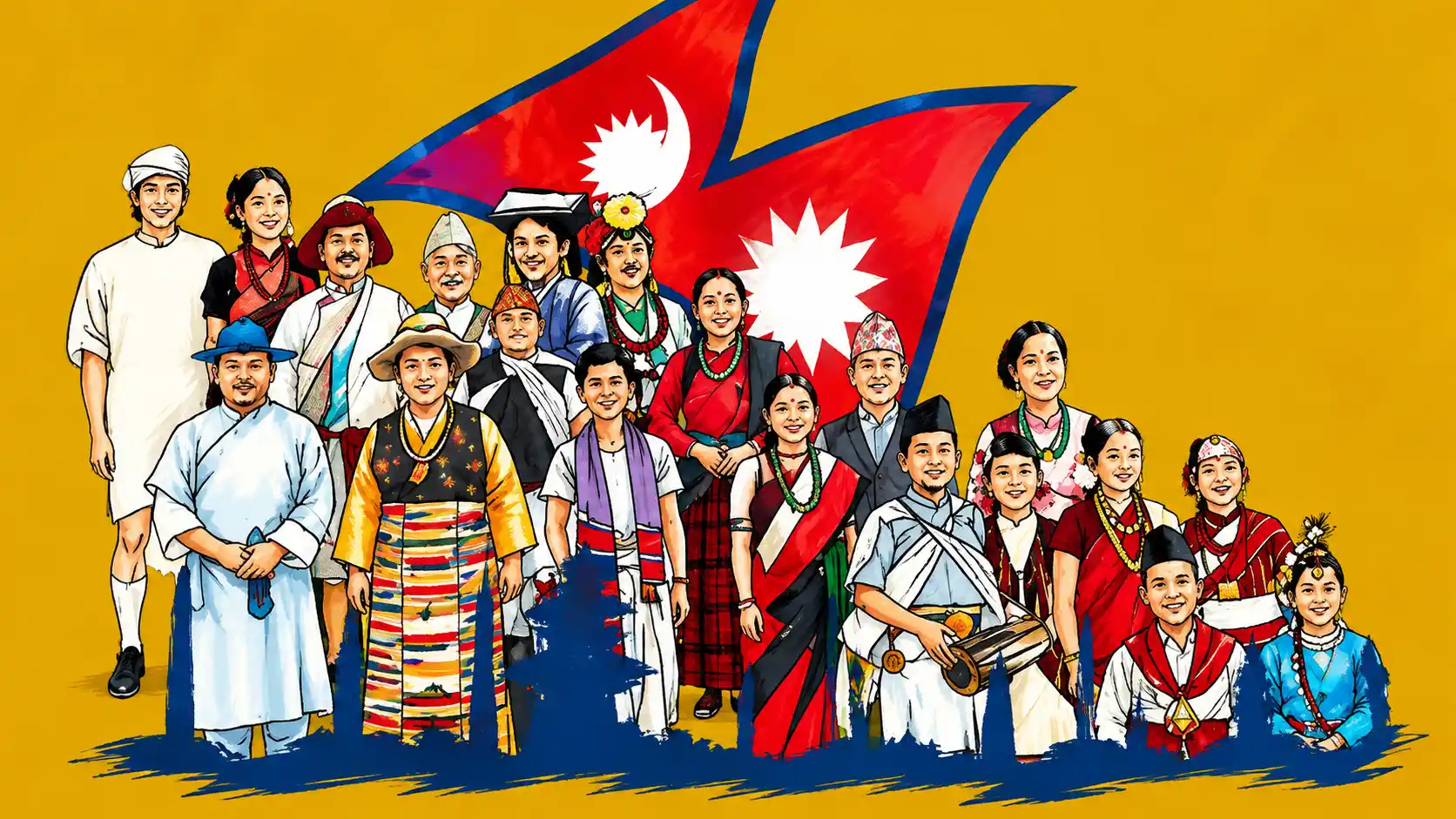

Explore Nepal culture and traditions, from ethnic groups and religion to festivals, food, dress, customs, and the unique living goddess Kumari.
Nepal is a small country. But its culture is huge.Wedged between India and Tibet, this Himalayan nation is home to 142 different ethnic and caste groups. Hindu and Buddhist traditions blend so closely here that the two faiths often share the same temple courtyard.
This guide covers Nepal’s culture and traditions: its people, religion, festivals, food, and everyday customs. You’ll also see how life in the mountains is different from life in the plains, and why that matters.Let’s start with the basics.
The People of Nepal: Ethnic Groups, Languages, and Geography
How Geography Shapes Nepali Culture
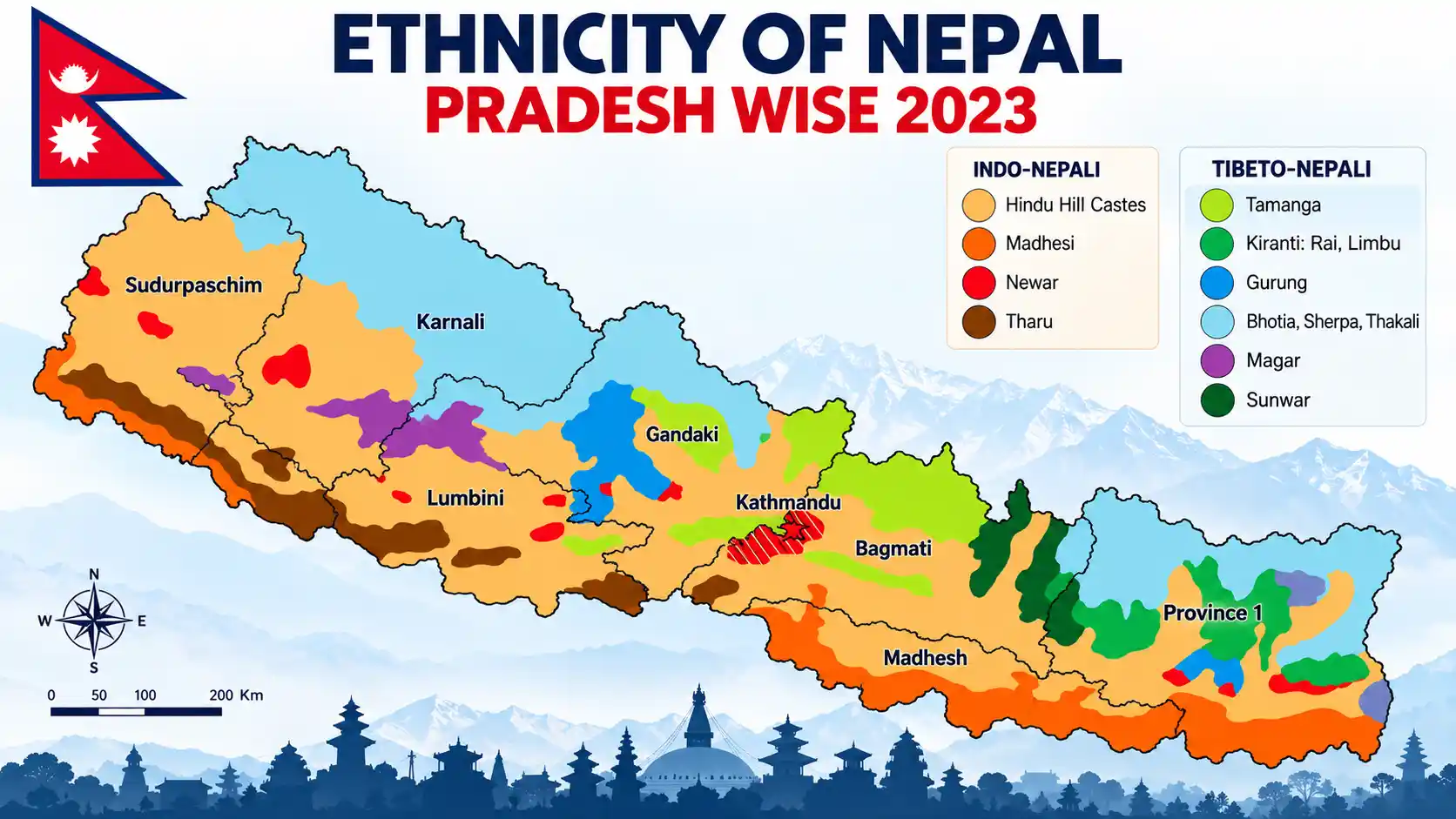
Nepal has three zones. Each one has its own way of life. In the high Himalaya, groups like the Sherpa and Tamang follow Tibetan-style Buddhist traditions. They wear thick, hand-woven wool clothing to survive the cold. In the middle hills, communities like the Newar, Gurung, Magar, and Brahmin-Chhetri built the temples and courtyards of the Kathmandu Valley. Down in the flat, warm Terai plains, the Tharu and other Madhesi communities live in distinctive clay houses and follow their own farming traditions.
Altitude does more than change the scenery here. It shapes what people wear, eat, and believe.
The Main Ethnic Groups in Nepal
So who exactly makes up Nepal’s population? According to the 2021 census, the largest groups are:
- Chhetri – 16.45%
- Hill Brahmin – 11.29%
- Magar – 6.9%
- Tharu – 6.2%
- Tamang – 5.62%
- Newar – about 4.6%
The remaining 136 groups make up the other 49% of the population, including the Gurung, Rai, and Limbu. Each one carries its own language, dress, and festivals.
The Languages Nepali People Speak
Language tells the same story of diversity. Nepal counted 124 mother tongues in its most recent census. Nepali is the most common, spoken by 44.86% of the population as a first language, and it works as the country’s shared language.
After Nepali, the most widely spoken languages are Maithili, Bhojpuri, Tharu, Tamang, and Bajjika, though Nepal Bhasa, the language of the Newar community, carries an outsized cultural role in the Kathmandu Valley.
With that many people, languages, and lifestyles, it’s no surprise that religion in Nepal is just as layered.
Religion in Nepal: Hindu, Buddhist, and Minority Faiths
What Is the Main Religion in Nepal?
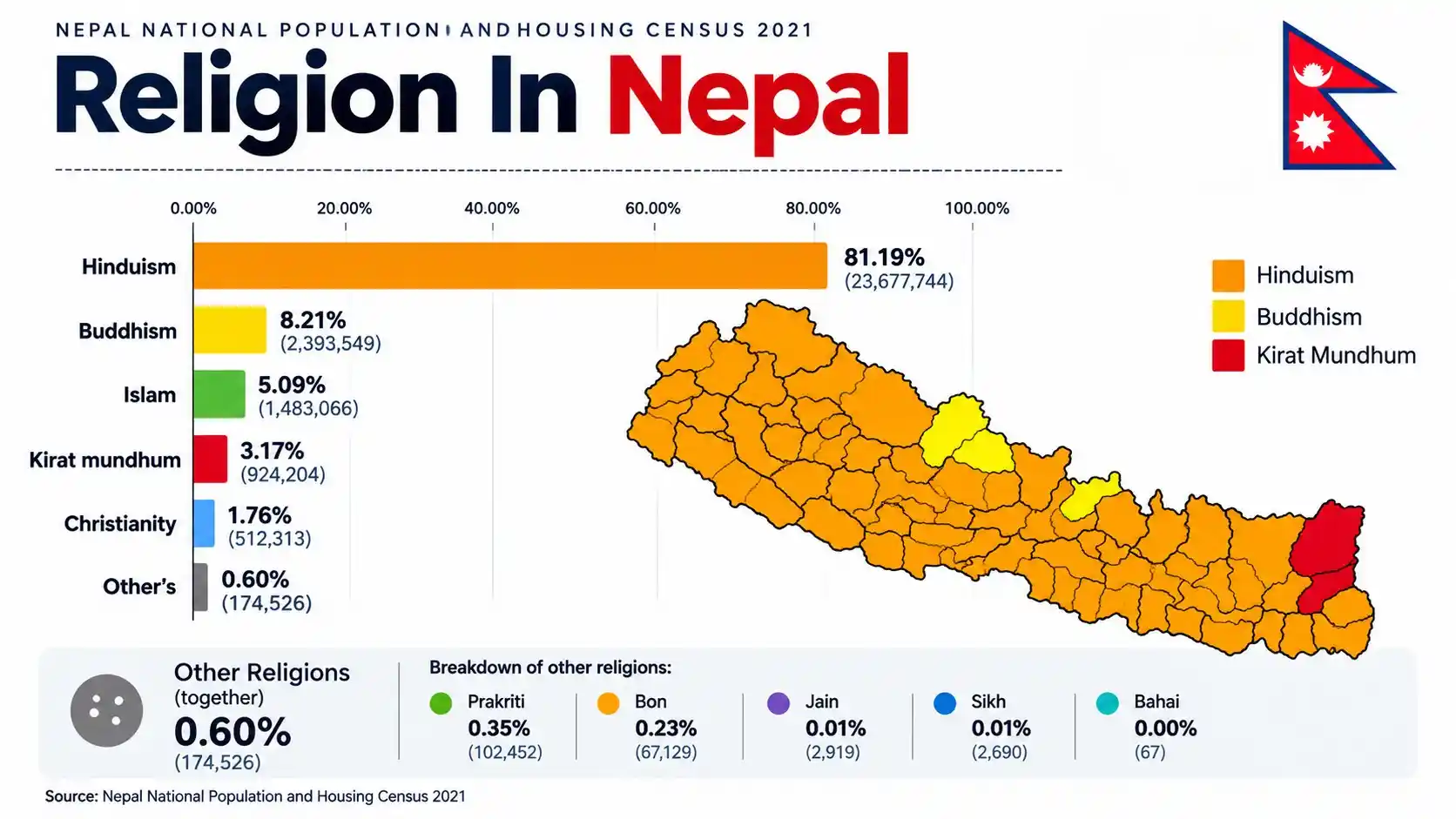
Hinduism is Nepal’s main religion, practiced by 81.19% of the population. Buddhism comes next, practiced by 8.21% of Nepalis. Religion touches nearly everything in Nepali daily life.
Hinduism and Buddhism have coexisted in Nepal for more than two thousand years. In places like the Kathmandu Valley, you’ll often find Hindu and Buddhist shrines sitting in the very same courtyard. Nepal’s parliament declared the country a secular state in May 2006, ending Hinduism’s status as the official state religion. That change didn’t make daily life less religious, though. Most Nepalis still build their day, week, and year around faith.
A smaller number of communities also carry on older tantric traditions, including ritual offerings. Most visitors never encounter this side of Nepali religion. It stays far less visible than the temples, prayer flags, and festivals most people see.
Buddhist Culture in Nepal
Buddhism holds a special place in Nepal. That’s because Lumbini, in the southern plains, is the birthplace of Siddhartha Gautama, the Buddha.
Around the country, you’ll find monasteries known as gumbas. Famous sites include Boudhanath Stupa and Swayambhunath, also called the Monkey Temple. Many people in the Sherpa and Tamang communities practice Buddhism. You’ll see it in the prayer flags snapping in the mountain wind and in prayer wheels marked with the mantra “Om Mani Padme Hum.”
Brahmin Culture in Nepal
Brahmin priests, also called Bahun, play a central role in Hindu ceremonies across Nepal. They study Sanskrit scripture and guide families through weddings, naming ceremonies, and other major life events.
Boys from Brahmin and other Hindu families traditionally receive a sacred thread, called a janai, during a coming-of-age ceremony. This thread marks their entry into religious life. We’ll cover that ceremony in more detail later in this guide.
Minority Faiths in Nepal
Nepal isn’t only Hindu and Buddhist. Smaller communities practice other faiths too:
- Islam arrived through Kashmiri traders as early as the 11th century, with settled communities established by the late 1400s, and is most common in the Terai region, making up about 5% of the population
- Christianity has grown in recent decades and now accounts for about 1.8% of Nepalis, with churches in most major cities
- The Kirat religion, an indigenous belief system centered on ancestor worship, is practiced by about 3% of the population, mostly among eastern hill communities like the Rai and Limbu
Out of all these beliefs, one Nepali tradition stands completely alone in the world.
The Kumari: Nepal’s Living Goddess
Nepal is the only country with a living goddess.
The Kumari is a young girl, chosen from the Newar Buddhist Shakya clan, who is worshipped as the living form of the Hindu goddess Taleju. Priests choose her using strict physical and astrological rules. Once chosen, she lives in a palace called the Kumari Ghar in central Kathmandu.
Both Hindus and Buddhists visit her to seek blessings. The Kumari holds the role until puberty, then returns to ordinary life while a new Kumari is chosen.
The Kumari tradition shows how Hinduism and Buddhism blend together in Nepal instead of staying separate.
Nepal’s Biggest Festivals and Celebrations
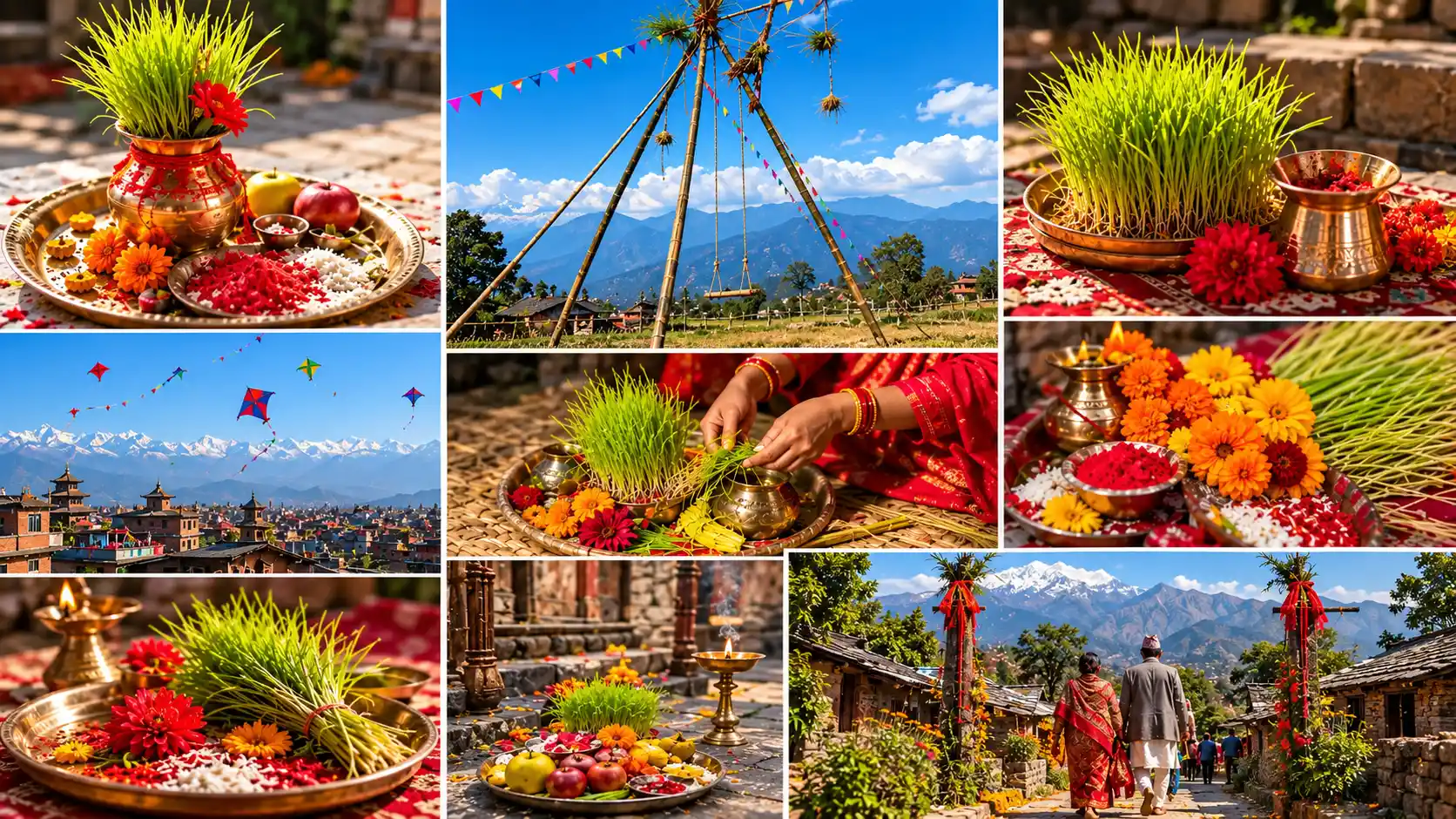
Festivals are the heartbeat of Nepali culture and traditions. They bring families home, fill the streets with music, and turn ordinary days into celebrations.
Dashain: The Grand Festival
Dashain is Nepal’s longest and most important festival. It lasts up to 15 days in September or October, and it celebrates the goddess Durga’s victory over the demon Mahishasura.
Families gather at their ancestral homes. Elders bless the younger generation with tika, a mix of rice, yogurt, and vermillion, and jamara, a bundle of barley sprouts. Children fly kites in the clear autumn sky. Communities build tall bamboo swings called linge ping.
Tihar: The Festival of Lights
Tihar follows Dashain and lasts five days. Unlike most festivals, it honors animals as well as people.
Each day is dedicated to a different creature: crows, dogs, cows, and oxen all receive offerings and respect. Homes glow with oil lamps and colorful lights. Families draw rangoli patterns on their doorsteps to welcome Laxmi, the goddess of wealth. The festival ends with Bhai Tika, when sisters bless their brothers for long life.
Other Major Festivals in Nepal
Nepal’s calendar stays full year-round:
- Holi – the festival of colors, marking the arrival of spring
- Buddha Jayanti – celebrating the birth, enlightenment, and death of the Buddha
- Teej – a festival for women, who fast and dance in red saris for their family’s wellbeing
- Losar – the Tibetan-style new year, celebrated by Sherpa and Tamang communities
- Indra Jatra – masked dances and a chariot procession for the Kumari, held in Kathmandu
- Mani Rimdu – a festival of masked monastic dances, celebrated by Sherpas near the Everest region
| Festival | Who Celebrates | When | Meaning |
| Dashain | Mostly Hindu communities | Sept–Oct | Victory of good over evil |
| Tihar | Nationwide | Oct–Nov | Bond between humans, animals, and gods |
| Holi | Nationwide | March | Arrival of spring |
| Losar | Sherpa, Tamang | Feb (varies) | Tibetan-style new year |
| Teej | Hindu women | Aug–Sept | Family wellbeing and devotion |
Why Nepal Celebrates Three New Years
Nepal celebrates three separate new years, one for each major calendar tradition in the country. The official Bikram Sambat calendar starts its new year, Navavarsha, in mid-April. The Newar community follows a separate calendar, called Nepal Sambat, with its new year in autumn. Sherpa and Tamang communities celebrate Losar on their own lunar schedule.
Festivals aren’t the only place Nepali identity shows up. You can see it clearly in what people wear and how they move.
Nepal Culture: Dress, Dance, and Folk Music
Traditional Nepal Culture Dress
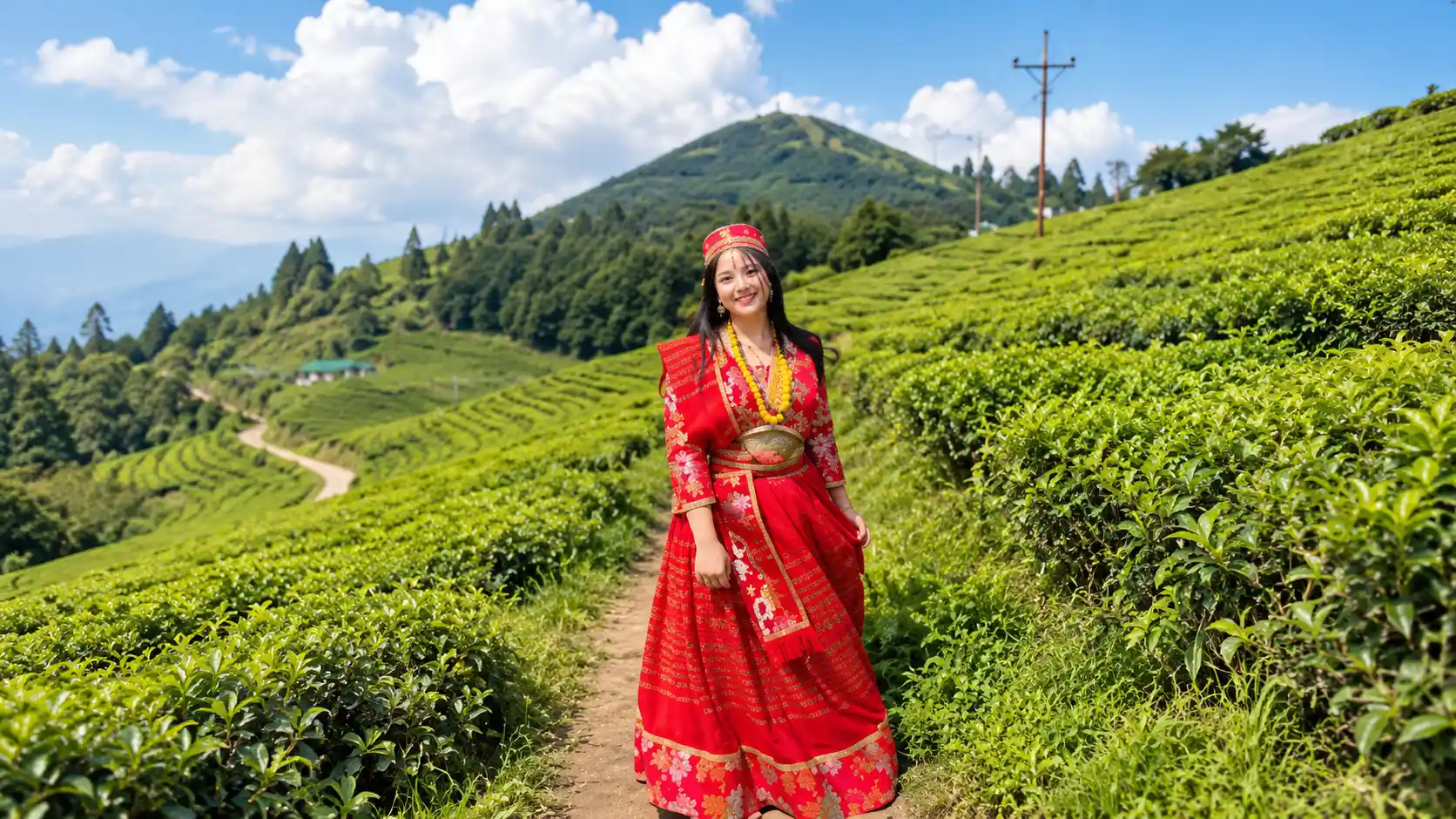
Nepal’s national dress reflects its hill traditions. Men traditionally wear the Daura-Suruwal, a wrapped shirt and trousers, often paired with a Dhaka topi cap. Women traditionally wear the Gunyo-Cholo, a wrap skirt and blouse.
Both outfits are still worn during festivals and formal occasions, even though everyday clothing has become more modern.
Folk Culture of Nepal: Dance and Music
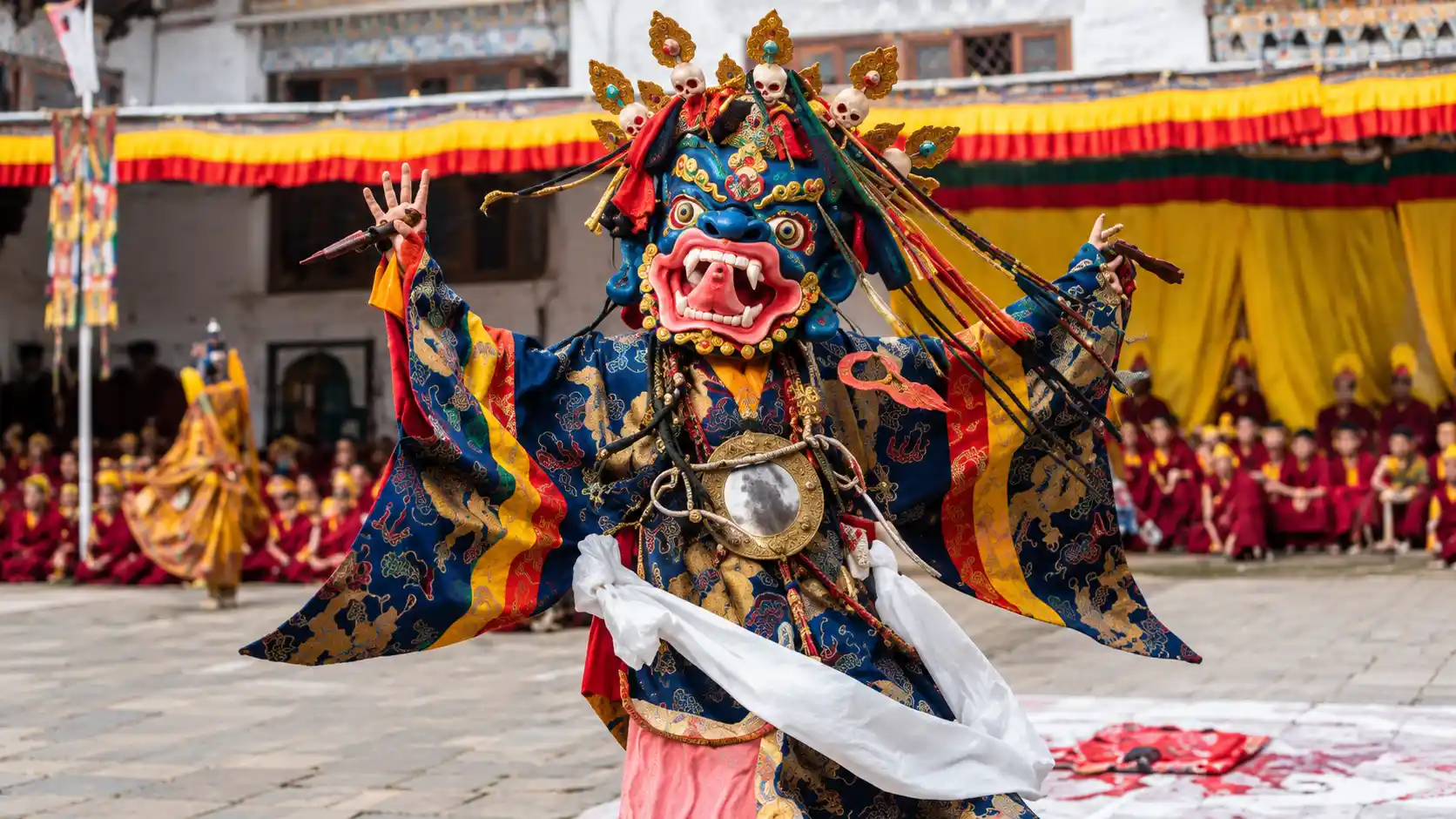
Nepali legend traces the origin of dance to Lord Shiva himself, said to have performed his cosmic tandava dance in the Himalayas. From that legend comes a rich variety of folk dances: the Tharu stick dance from the southern plains, playful peacock dances, and the intricate Dishka dance performed at weddings.
Traditional music relies on instruments like the sarangi, a bowed string instrument, and the madal, a hand drum that drives the rhythm at nearly every festival.
Nepal’s artistic traditions aren’t only in motion, though. Some of them are carved in stone and wood, and they’ve lasted for centuries.
Cultural Heritage Sites in Nepal
The Kathmandu Valley itself is UNESCO World Heritage Site, made up of seven separate monument zones. These include the Durbar Squares of Kathmandu, Patan, and Bhaktapur, along with the great stupas of Swayambhunath and Boudhanath and the sacred Pashupatinath temple complex.
Every building tells a story through its wood carvings, many centuries old and made by Newar artisans whose skills have passed down through generations. To the south, Lumbini stands as its own UNESCO World Heritage Site, marking the exact spot where the Buddha was born. After all that sightseeing, you’ll want to know what’s on the plate.
Food and Nepal Culture: What People Eat
Dal-Bhat: The Everyday Staple
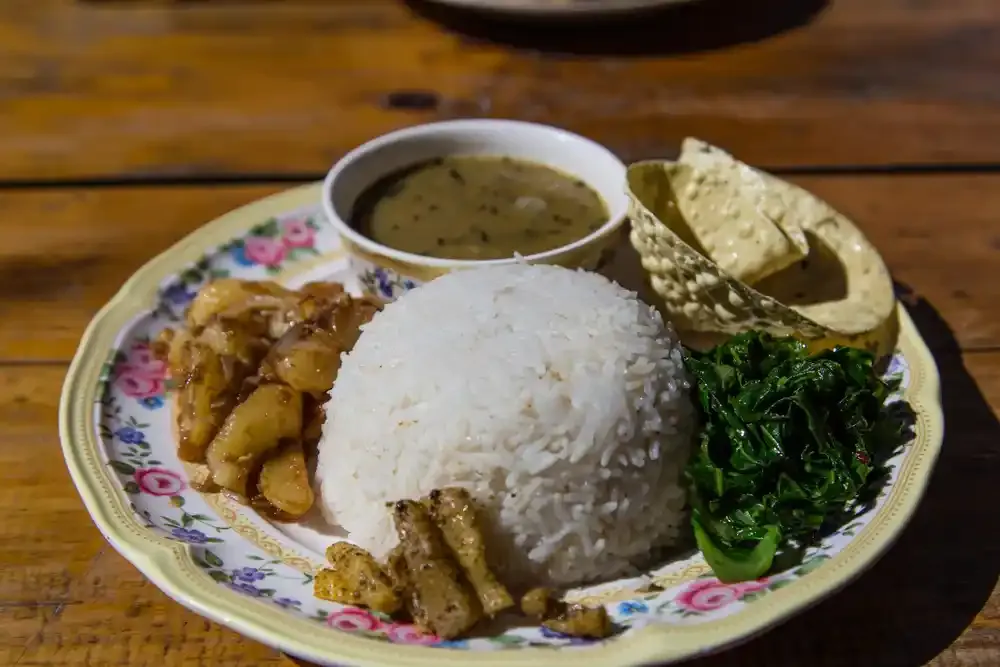
Most Nepalis eat dal-bhat-tarkari nearly every day. That’s lentil soup, boiled rice, and curried vegetables, usually served with a side of pickle called achar. Dal-bhat is simple, filling, and central to daily life across the country.
Momo and Regional Specialties
Momo, steamed or fried dumplings filled with meat or vegetables, are Nepal’s most popular snack and a genuine source of national pride.
Beyond the everyday staples, regional communities have their own signature cuisines. The Newar community of the Kathmandu Valley has an especially rich food culture, with dozens of traditional dishes served at feasts. The Thakali people of the Mustang region are known for a distinct style of thali, or platter meal, that has become popular well beyond their home region.
Food connects to something deeper too: the ceremonies that mark each stage of a Nepali life.
Life-Cycle Rituals and Rites of Passage in Nepal
Nepali culture marks nearly every stage of life with a ceremony. Soon after a baby is born, families hold the Nuwaran, a naming ceremony where a priest chooses an auspicious name. A few months later comes the Pasni, when the baby tastes solid food for the first time, usually rice, fed by an elder as a wish for lifelong health.
As boys approach their teenage years, Hindu families hold the Bratabandha ceremony, marking their entry into religious adulthood. The boy receives a sacred thread and learns the responsibilities he’ll carry as a member of his faith and community.
One of the most distinctive rituals belongs to the Newar community: Bel Bibaha, also called Ihi. Before a young girl reaches puberty, she takes part in a ceremony where she’s symbolically married to a wood apple, or bel fruit, which represents the Hindu god Vishnu. Because her true “husband” is a deity who can never die, the ritual is meant to protect her from the social stigma once attached to widowhood later in life.
These rituals shape private family life. But Nepali culture and customs also shape something more public: how people treat each other every single day.
Nepal Culture and Customs: Everyday Etiquette
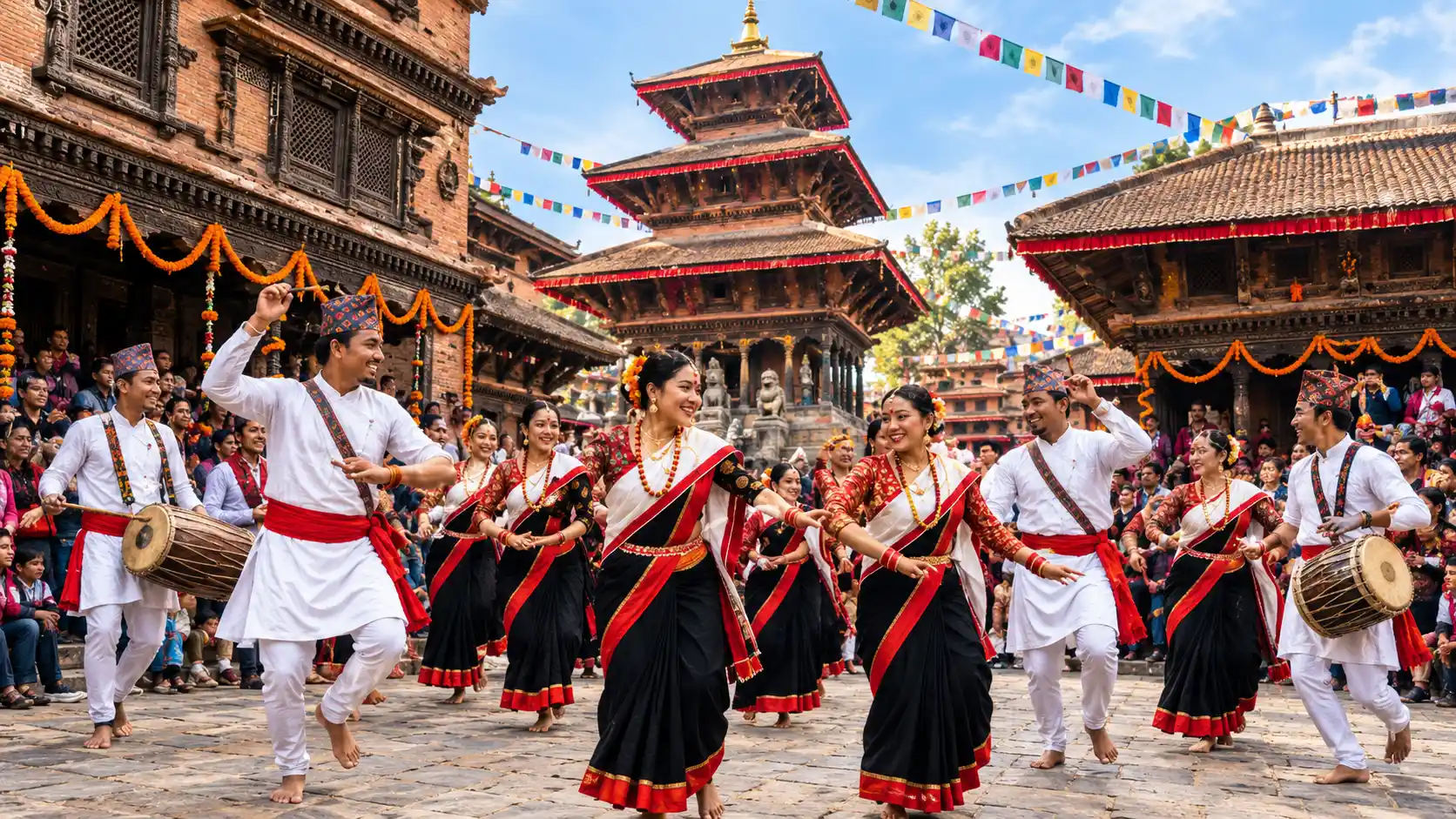
Hospitality runs deep in Nepal, where guests are often treated as sacred. Visitors are usually offered tea the moment they arrive, and it’s polite to accept, even a small sip.
Everyday life follows a few clear customs. Greet people with a soft “Namaste” and pressed palms. Use your right hand for eating, giving, and receiving objects. Remove your shoes before entering a home or temple.
Here’s a simple reference table:
| Do | Don’t |
| Greet with “Namaste” and a slight bow | Point your feet at people or religious statues |
| Use your right hand to give or receive items | Touch someone’s head, which is considered sacred |
| Remove your shoes before entering a home or temple | Wear leather items inside Hindu temples |
| Dress modestly, especially at religious sites | Show public displays of affection |
| Ask permission before photographing people or shrines | Eat or pass food with your left hand |
| Walk clockwise around stupas and prayer wheels | Interrupt someone praying or making an offering |
Now that you know how Nepalis live day to day, here are a few extra facts about Nepal’s culture that surprise most people.
Fun Facts About Nepal’s Culture
- Nepal now recognizes 142 ethnic and caste groups, up from 125 just a decade earlier
- The Bikram Sambat calendar runs about 56 to 57 years ahead of the Gregorian calendar
- Nepal’s flag is the only national flag in the world that isn’t rectangular, made of two overlapping triangles
- Nepal has never been colonized, so it doesn’t celebrate an Independence Day
- The cow is Nepal’s national animal, and cow slaughter is illegal
- Nepal is home to the legendary Gurkha soldiers, known worldwide for their bravery and their curved kukri knives
Conclusion
Nepal’s culture isn’t one single thing. It’s a living mix of over a hundred ethnic groups, two major religions that share the same courtyards, and traditions shaped by everything from Himalayan peaks to tropical plains.
Even as cities like Kathmandu grow more modern, families still gather for Dashain. Priests still perform centuries-old rites of passage. Travelers still remove their shoes before stepping into a temple. That’s the real story of Nepal and its culture: old and new, living side by side.
FAQs About Nepal’s Culture and People
What is the main religion in Nepal?
Hinduism is the majority religion in Nepal, practiced by about 81% of the population. Buddhism is the second-largest faith, followed by about 8% of Nepalis.
What do you call people from Nepal?
People from Nepal are called Nepali or Nepalese. “Nepali” is also the name of the country’s official language.
What is Nepal’s national dress?
Nepal’s national dress is the Daura-Suruwal, often worn with a Dhaka topi cap, for men, and the Gunyo-Cholo for women.
What is the biggest festival in Nepal?
Dashain is Nepal’s biggest festival, the longest celebration of the year, at up to 15 days, marking the goddess Durga’s victory over evil.
What makes Nepali culture unique?
Nepali culture blends Hinduism and Buddhism across more than 140 ethnic groups, all within a landscape that ranges from tropical plains to the highest mountains on Earth. Traditions like the living goddess Kumari exist nowhere else in the world.
0 Comment