
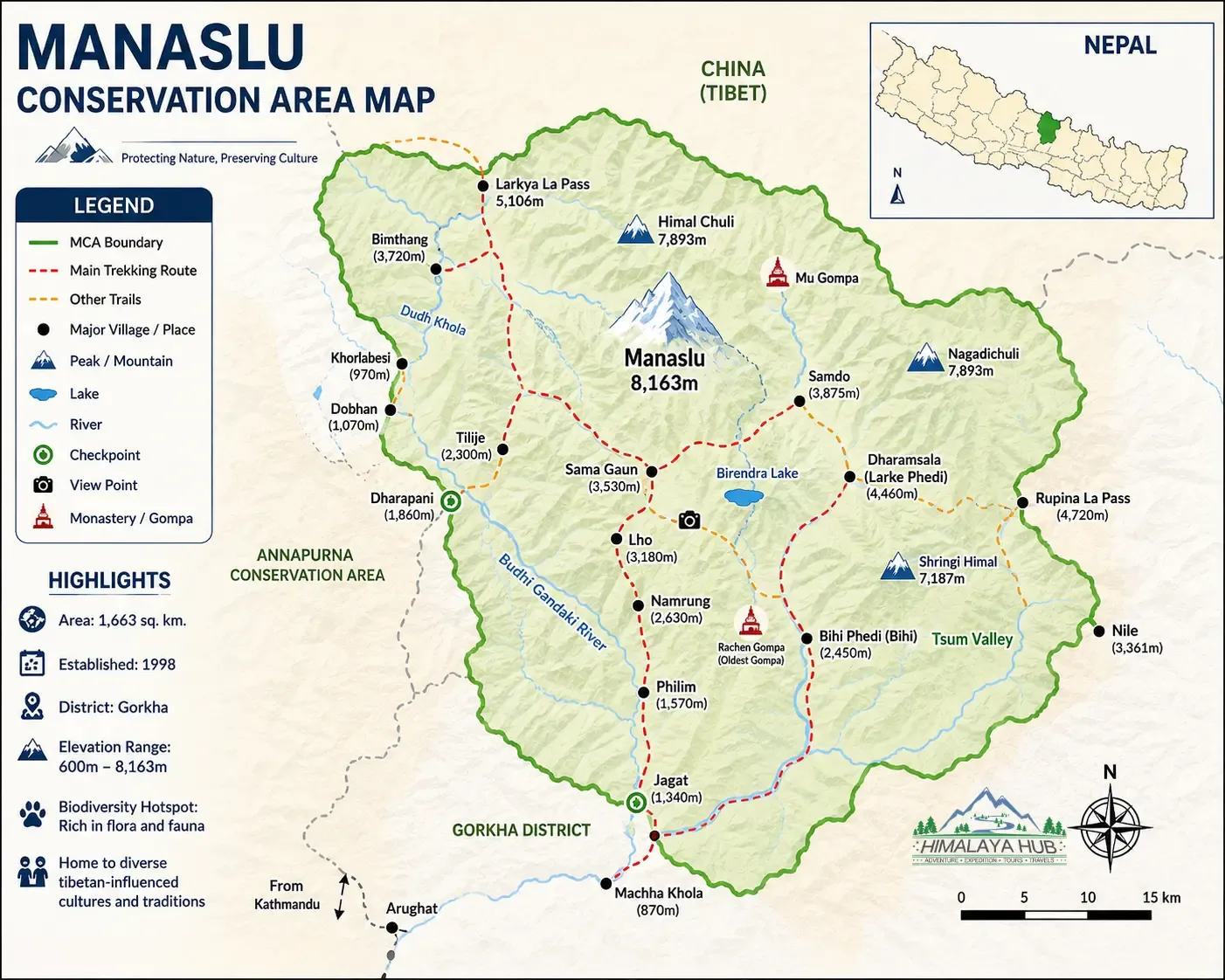

Welcome to your guide for the Manaslu Circuit Trek Map! Below, you will find a custom, high-quality map we made just for you. A good map is the most valuable tool for your trip. It shows exactly where the trails are, the cozy tea houses where you will sleep, and the exciting suspension bridges you will cross over the rivers.
The Manaslu Trek is a peaceful and quiet choice compared to the busy Annapurna Circuit. As you hike, you will walk right through the Manaslu Conservation Area. This is a special, protected nature zone where beautiful forests grow and rare animals, like snow leopards and red pandas, live safely.
Our map is packed with helpful details to keep you safe. You can use it to find the best spots to rest your body (acclimatization) so you do not get altitude sickness. It also highlights the secret path to the beautiful Tsum Valley and the highest, most thrilling point of the whole trek: the giant Larkya La Pass (5,106 meters)!
If you want to see all these small details up close, just double-click on the map to zoom in.
Whether you are planning a 13-day or a 16-day adventure, checking this map will help you understand your daily walks, rest days, and steep climbs before you even pack your bags!
Where Does the Manaslu Trek Start and End?
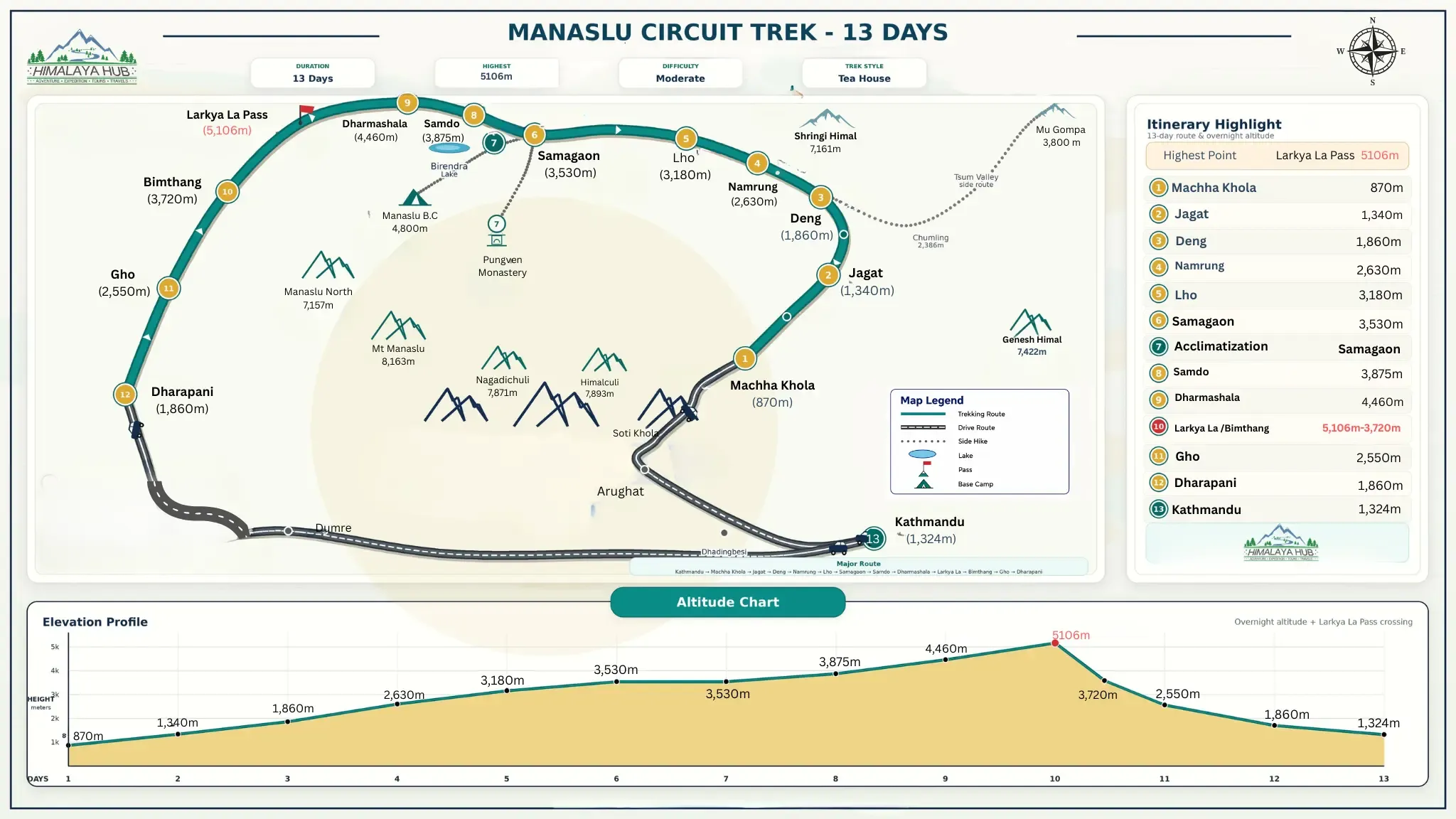
When you look at the Manaslu Circuit Trekking map, the route makes a giant loop. To plan your trip, you must know the exact map points: the trek starts at Machha Khola and ends at Dharapani.
The Starting Point
Your trip begins with a drive from Kathmandu, but the actual walking starts at Machha Khola (930 meters). After a long jeep ride, you get out here. This village is the exact spot on the map where your hike officially begins!
The Ending Point
The walking part of your map finishes at Dharapani (1,860 meters). After crossing the high mountains, you stop hiking here. From Dharapani, your trek is over, and you take a jeep back to Kathmandu.
Connection with Annapurna and Tsum Valley
Your map also shows two exciting trail connections:
- Tsum Valley: Halfway through your hike, a side path splits off to this hidden, peaceful valley.
- Annapurna Circuit: When you reach your finish line in Dharapani, you are actually stepping right onto the famous Annapurna trail!
Since these paths connect so perfectly on the map, it is super easy to add extra exploring to your big adventure! You can pick a ready-made combo like the Manaslu and Annapurna Circuit Trek (18 Days) or the Tsum Valley and Manaslu Circuit Trek (18 Days). Or, if you have your own timeline, you can even customize your own tour with Himalaya Hub to make the trip fit your schedule perfectly!
Tell us your travel plans and we'll create a personalized itinerary based on your budget, interests, and schedule.
Manaslu Trekking Map 13 Days
Here is a quick look at your daily Manaslu Trekking itinerary 13 days to help you follow along with the map:
Day 01: Drive from Kathmandu to Machha Khola
Elevation: 870m (2,854 ft)
Distance: 160 km (99.4 mi)
Duration: 10–12 hours
Accommodation: Teahouse The journey begins with a scenic drive from Kathmandu to Machha Khola, passing through hills, rivers, and terraced fields.
Day 02: Trek from Machha Khola to Jagat
Elevation: 1,340m (4,396 ft)
Distance: 22 km (13.7 mi)
Duration: 6–7 hours
Accommodation: Teahouse Today begins your trekking journey along the Budhi Gandaki River through green subtropical forests, terraced farms, and traditional villages. Pass through Khorlabesi, Tatopani, Dobhan, and Thulo Dunga before reaching Jagat.
Day 03: Trek from Jagat to Deng
Elevation: 1,860m (6,102 ft)
Distance: 19–22 km (11.8–13.7 mi)
Duration: 6–7 hours
Accommodation: Teahouse The trail follows the Budhi Gandaki River through forests and suspension bridges, passing villages like Sirdibas, Philim, Ekle Bhatti, Salleri, and Pewa before reaching Deng.
Day 04: Trek from Deng to Namrung
Elevation: 2,630m (8,628 ft)
Distance: 18–20 km (11.2–12.4 mi)
Duration: 6–7 hours
Accommodation: Teahouse Trek through thick forests and Gurung villages, passing Bihi Phedi, Ghap, and Ghapsya. Tibetan Buddhist culture becomes prominent as you reach Namrung.
Day 05: Trek from Namrung to Lho
Elevation: 3,160m (10,367 ft)
Distance: 10 km (6.2 mi)
Duration: 5 hours
Accommodation: Teahouse The trail climbs through alpine forests and traditional Tibetan villages with spectacular views of Mount Manaslu before reaching Lho.
Day 06: Trek from Lho to Samagaon via Pungen Gompa
Elevation: 3,530m (11,581 ft) via Pungen Gompa (4,000m / 13,123 ft)
Distance: 14–16 km (8.7–9.9 mi)
Duration: 6–7 hours
Accommodation: Teahouse This day features a visit to the serene Pungen Gompa and continues through the upper Nubri Valley before reaching Samagaon.
Day 07: Acclimatization Day at Samagaon and Visit Manaslu Base Camp
Elevation: 4,800m (15,748 ft) at Base Camp
Distance: 5–6 km (3.1–3.7 mi) one way
Duration: 6–7 hours
Accommodation: Teahouse A crucial acclimatization day with an optional hike to Manaslu Base Camp, Birendra Lake, or nearby viewpoints.
Day 08: Trek from Samagaon to Samdo
Elevation: 3,875m (12,713 ft)
Distance: 8–10 km (5–6.2 mi)
Duration: 3–4 hours
Accommodation: Teahouse The trail leads to Samdo, the last settlement before Larkya La Pass, passing alpine meadows and yak grazing pastures.
Day 09: Trek from Samdo to Dharmashala (Larkya Base Camp)
Elevation: 4,460m (14,632 ft)
Distance: 6–8 km (3.7–5 mi)
Duration: 4–5 hours
Accommodation: Teahouse This section offers mesmerizing alpine views as trekkers prepare for the Larkya La Pass crossing.
Day 10: Trek from Dharmashala to Bimthang via Larkya La Pass
Elevation: 5,106m (16,752 ft) at pass, 3,590m (11,778 ft) at Bimthang
Distance: 16 km (9.9 mi)
Duration: 10 hours
Accommodation: Teahouse Cross Larkya La Pass, the highest point of the trek, then descend through glacial valleys to Bimthang.
Day 11: Trek from Bimthang to Gho
Elevation: 2,550m (8,366 ft)
Distance: 13–14 km (8.1–8.7 mi)
Duration: 5–6 hours
Accommodation: Teahouse Descend through rhododendron forests and alpine meadows via Karche and Yak Kharka to reach Gho.
Day 12: Trek from Gho to Dharapani
Elevation: 1,860m (6,102 ft)
Distance: 10–12 km (6.2–7.5 mi)
Duration: 3 hours
Accommodation: Teahouse An easy descent through forests and villages like Tilije and Thonje before reaching Dharapani.
Day 13: Drive from Dharapani to Kathmandu
Elevation: 1,324m (4,344 ft)
Distance: 210 km (130.5 mi)
Duration: 10 hours
Drive from Dharapani to Besisahar by shared jeep, then continue by bus to Kathmandu, concluding your Manaslu Circuit adventure.
Manaslu Circuit Trek Map 16 Days
Here is a quick look at your daily Manaslu Trekking itinerary 16 days to help you follow along with the map:
Day 01: Arrival in Kathmandu
Elevation: 1,345 m (4,413 ft)
Duration: 1–2 hours (airport transfer + check‑in)
Distance: 5–7 km (3.1–4.3 mi)
Accommodation: Hotel Arrival at Tribhuvan International Airport (TIA). Transfer to your hotel and trek briefing.
Day 02: Kathmandu Valley Sightseeing
Elevation: 1,345 m (4,413 ft)
Duration: Full Day (6–8 hours sightseeing)
Distance: 25–45 km (15.5–28.0 mi)
Accommodation: Hotel Guided sightseeing of UNESCO World Heritage Sites including Swayambhunath (Monkey Temple), Patan Durbar Square, Pashupatinath Temple, and Boudhanath Stupa. Evening trek preparation.
Day 03: Drive from Kathmandu to Soti Khola
Elevation: 710 m (2,329 ft)
Distance: 140–160 km (87–99 mi)
Duration: 7–9 hours
Accommodation: Lodge / Basic Hotel Scenic drive to Soti Khola via Arughat in the Gorkha district. Road conditions may affect total travel time.
Day 04 : Trek from Soti Khola to Machha Khola
Elevation: 870 m (2,854 ft)
Distance: 14 km (8.7 mi)
Duration: 5–7 hours
Accommodation: Lodge / Guest House Trek along the Budhi Gandaki River through forests and small villages.
Day 05: Trek from Machha Khola to Jagat
Elevation: 1,340 m (4,396 ft)
Distance: 19–22 km (11.8–13.7 mi)
Duration: 6–8 hours
Accommodation: Teahouse Trek past Tatopani (hot springs area) and continue through villages before reaching Jagat.
Day 06: Trek from Jagat to Deng
Elevation: 1,860 m (6,102 ft)
Distance: 19–20 km (11.8–12.4 mi)
Duration: 7–8 hours
Accommodation: Teahouse Long trekking day with steady ascent through forest trails and traditional settlements.
Day 07: Trek from Deng to Namrung
Elevation: 2,630 m (8,628 ft)
Distance: 16–19 km (9.9–11.8 mi)
Duration: 6–7 hours
Accommodation: Teahouse Trek through forested trails and culturally rich villages before arriving at Namrung.
Day 08: Trek from Namrung to Samagaun (Sama Gaon)
Elevation: 3,530 m (11,581 ft)
Distance: 17–18 km (10.6–11.2 mi)
Duration: 6–8 hours
Accommodation: Teahouse Gradual ascent with monastery visits and Himalayan views before reaching Samagaun.
Day 09: Acclimatization Day in Samagaun
Elevation: 3,530 m (11,581 ft)
Distance: 6–10 km (3.7–6.2 mi) optional hike
Duration: 4–7 hours (optional hike)
Accommodation: Teahouse Acclimatization day with optional hike toward Manaslu Base Camp viewpoints or nearby glacier routes.
Day 10: Trek from Samagaun to Samdo
Elevation: 3,875 m (12,713 ft)
Distance: 8 km (5.0 mi)
Duration: 3–4 hours
Accommodation: Teahouse Short and scenic trek to Samdo, the last major settlement before Larkya La Pass.
Day 11: Trek from Samdo to Dharmashala (Larkya La Phedi)
Elevation: 4,460 m (14,632 ft)
Distance: 11 km (6.8 mi)
Duration: 4–5 hours
Accommodation: Teahouse Trek through alpine landscapes with expanding views toward Dharmashala, also known as Larkya La Phedi.
Day 12: Trek to Bimthang via Larkya La Pass
Highest Elevation: 5,106 m (16,752 ft) – Larkya La Pass
Overnight Elevation: 3,590 m (11,778 ft) – Bimthang
Distance: 14–16 km (8.7–9.9 mi)
Duration: 8–10 hours
Accommodation: Teahouse Cross the dramatic Larkya La Pass and descend through glacial valleys to Bimthang.
Day 13: Trek from Bimthang to Tilije
Elevation: 2,300 m (7,546 ft)
Distance: 19–26 km (11.8–16.1 mi)
Duration: 5–8 hours
Accommodation: Guest House Long descent through forests and pasturelands via traditional villages to Tilije.
Day 14: Trek from Tilije to Dharapani
Elevation: 1,860 m (6,102 ft)
Distance: 13–18 km (8.1–11.2 mi)
Duration: 4–5 hours
Accommodation: Guest House Follow the Marsyangdi River valley to Dharapani, the Annapurna Circuit junction.
Day 15: Drive from Dharapani to Kathmandu
Elevation: 1,345 m (4,413 ft)
Distance: 200–260 km (124–162 mi)
Duration: 8–12+ hours
Accommodation: Hotel Jeep drive to Besisahar followed by bus or private vehicle transfer to Kathmandu. Travel time varies depending on road conditions.
Day 16: Final Departure
Elevation: 1,345 m (4,413 ft)
Duration: 30–60 minutes
Distance: 5–7 km (3.1–4.3 mi)
Accommodation: (Departure day / no overnight). Transfer to the airport for your onward destination or optional extended trip.
Highlights on the Manaslu Circuit Trek Map
The Manaslu Circuit Trek map highlights major landmarks, highest passes, base camps, villages, and optional side trips helping trekkers understand altitude gain, acclimatization points, distance between villages, and the key attractions along this remote Himalayan route.
Manaslu Base Camp (4,800m)
The map shows a popular side trip from Samagaon to Manaslu Base Camp, one of the top highlights of the Manaslu Base Camp trek. This acclimatization hike offers breathtaking views of Mount Manaslu (8,163m), glaciers, and surrounding Himalayan peaks. Though optional, it is highly recommended before crossing Larke La Pass.
Larkya La Pass (5,106 m) – Highest Point of the Trek
Marked as the highest elevation on the route, Larkya La Pass (5,106 m) (also written as Larke Pass) is the most demanding and rewarding section of the Manaslu Circuit. The crossing day typically runs from Dharmashala / Dharamsala (Larkya Phedi) to Bimthang, involving a long ascent followed by a steep descent. From the top, trekkers enjoy panoramic mountain views including Himlung Himal, Cheo Himal, Kang Guru, and Annapurna II.
Tsum Valley Trek Extension
Many detailed Manaslu trek maps also show the optional Tsum Valley trek route , a restricted and culturally rich side trip. This hidden valley is famous for Mu Gompa, Rachen Gompa, and traditional Tibetan Buddhist culture, making it ideal for trekkers seeking a deeper cultural experience.
Samagaon and Birendra Lake
The map highlights Samagaon village, the main acclimatization stop on the Manaslu Circuit. Nearby, trekkers can visit Birendra Lake, a beautiful glacial lake located at the base of Manaslu. This short hike is often marked as an easy side excursion.
Key Villages Along the Manaslu Trekking Route
Important villages marked on the Manaslu trekking map include:
- Namrung – Gateway to upper Nubri region
- Lho Village – Famous for Ribung Monastery and first clear Manaslu views
- Samdo – High-altitude village near the Tibet border
- Bimthang – Scenic valley after crossing Larke Pass
These villages serve as rest points, tea house stops, and cultural highlights of the trek.
Budhi Gandaki River & Suspension Bridges
The lower section of the Manaslu Circuit follows the Budhi Gandaki River, with multiple suspension bridges and dramatic gorges. This feature is commonly marked on trekking maps and adds adventure to the early days of the trek.
Tips for Using the Manaslu Trek Map
Learn to Read the Map Before You Start
Before starting the Manaslu Circuit Trek, study your Manaslu trek map carefully. Understand the legend (symbols for villages, rivers, bridges, tea houses, and trails) and pay close attention to contour lines and altitude markers. On the Manaslu trekking route, elevation gain matters more than distance, especially on long sections between settlements.
Check Alternative Routes and Side Trips
A detailed Manaslu Circuit Trek map shows key side trips like Manaslu Base Camp from Samagaun and the Tsum Valley Trek extension. Use the map to plan distance, time, and permit requirements while keeping your Manaslu Trekking itinerary flexible.
Monitor Elevation and Acclimatization Points
Altitude is a major challenge on the Manaslu Circuit Trek Nepal. The trail climbs above 3,500 m and crosses Larkya La Pass (5,106 m). Track daily elevation gain and acclimatization stops like Samagaun to reduce the risk of altitude sickness.
Use the Map with Local Guidance
Your Manaslu trek route map is essential, but conditions can change due to weather or landslides. Combine your map with advice from a licensed guide and locals for safer navigation and a richer trekking experience.
Additional Tips for a Successful Manaslu Circuit Trek
Best Time for Manaslu Circuit Trek
The best time for the Manaslu Circuit Trek is autumn (September–November) and spring (March–May). During autumn, the weather is stable, skies are clear, and conditions are ideal for crossing Larkya La Pass (5,106 m). Spring offers moderate temperatures, good visibility, and blooming rhododendron forests in lower sections. Avoid peak monsoon (June–August) due to landslides and poor trail conditions.
Acclimatization (Altitude Safety Tips)
The Manaslu Circuit Trek Nepal involves multiple nights above 3,500 meters, increasing the risk of altitude sickness. Most standard itineraries include an acclimatization day in Samagaun (3,530 m) before ascending to Samdo and Dharmashala. Follow gradual ascent rules, stay hydrated, and monitor symptoms such as headache, dizziness, or nausea especially before attempting Larkya La Pass.
Packing Essentials (What to Pack for Manaslu Circuit Trek)
A proper packing list should focus on layering and cold protection. Essential items include thermal base layers, insulated down jacket, waterproof shell, warm sleeping bag (rated for sub-zero temperatures), broken-in trekking boots, trekking poles, headlamp, water purification tablets, and sun protection. Weather conditions can change rapidly at higher elevations.
Permits and Requirements (Manaslu Circuit Trek Permits)
The permits are mandatory as the region is classified as a restricted area of Nepal. Trekkers require:
- Manaslu Restricted Area Permit (RAP)
- Manaslu Conservation Area Permit (MCAP)
- Annapurna Conservation Area Permit (ACAP)
Permit regulations and fees may change for Manaslu Circuit Trek 2026, so verify updated rules before departure.
Using Digital Tools with the Manaslu Trek Map
Your smartphone is an amazing tool for the Manaslu Trek! By downloading offline maps like Maps.me or Gaia GPS before your trip, your hike becomes much safer and easier.
How do these tools help you?
- Works Without Internet: Your phone’s GPS tracks you even in remote mountains with no Wi-Fi or phone signal.
- Pinpoints Your Location: The app puts a dot exactly where you are standing. If the trail is confusing or snowy, you will not get lost!
- Tracks Distance and Height: You can check exactly how high you have climbed and how many hours are left until the next warm tea house.
The Big Benefit: These tools help you pace your walking, avoid altitude sickness, and cross the high Larkya La Pass safely. Just remember to keep a paper map as a backup in case your battery dies!
Conclusion
The Manaslu Circuit Trek Map is your best tool for this amazing adventure. It shows your whole journey, from starting your walk at Machha Khola to finishing at Dharapani. It also shows your biggest climb up to the Larkya La Pass (5,106 meters)!
Looking at the map makes it easy to add extra adventures, like the hidden Tsum Valley or the famous Annapurna Circuit. You can pick a ready-made trip, like our 18-day combo treks, or easily customize your tour with Himalaya Hub to fit your own schedule.
Study your map, pack your bags, and get ready for an unforgettable hike in Nepal!
Reviews


Himalaya Hub Adventure executive director Ramesh gave us all the necessary in...
Himalaya Hub Adventure executive director Ramesh gave us all the necessary information to make our holiday really special and memorable. He attended to all our needs and gave a highly competitive quote. He provided us excellent vehicles and drivers and guide.
We set out from Kathmandu by road and visited Manakamana temple on the way to Pokhara. After a day of sightseeing in Pokhara including watching sunrise from Sarangkot viewpoint, we took next day early morning public bus to Ghandruk from where started our trek towards Tadapani . It is an ancient trade route and gives really memorable and special experiences but unfortunately we had continuous rain from the moment we started the trekking. Due to the clouds we missed the beautiful views of Himalayas which this trekking route is really famous for. We also spent some tense time in Tatopani due to the landslides along Kali Gandaki river where our guide took some excellent decisions to keep us safe.
Overall it was a great experience.
Ramit is a very good guide - very caring, knowledgeable, and always making sure I was safe and comfortable. He managed everything perfectly from hotels to food to permits. The only downside was the weather. Because of heavy rain, we couldn't see the good views from Ghorepani/Poon Hill and the trail became quite slippery and dangerous in some parts. But that's nature, nothing anyone can control, and he handled it very professionally and kept me safe. He took excellent decisions when faced with challenges posed by extreme weather conditions such as choosing a hotel accommodation at higher ground to keep us in safety in case of a flood and landslide. He sought required information for taking decisions regarding our trekking progress in difficult weather. He tested the path for safe crossing to minimise the risks that we were exposed to. He listened to our special needs and requirements and tried his best to meet with them such as ensuite accommodation, hot water, vegetarian food etc. His choice of teahouses and hotels were excellent.
Highly recommend Himalaya Hub Adventures for Nepal holiday packages.
Highly recommend Ramit Surkheti for anyone planning to trek in Nepal.

This tour is in the Himalayan hills and is relatively easy (ave. 6 hrs trekking per day). Lovely village sceneries, see Nepali agriculture, walks through the jungle and stiff climbs sometimes. 💪🏽
Communication with Puru of Himalaya Hub Adventures to book the tour and get all the details was very smooth.
Highly recommended!

From the morning pickup, bus transport, and hotel in Pokhara, through each day of trekking and our return to Kath...
From the morning pickup, bus transport, and hotel in Pokhara, through each day of trekking and our return to Kathmandu, everything was taken care of seemlessly.
Their well trained guide/porter Karan made every effort to see that we had a great experience.
This was our second time using Himalaya Hub, we had an excellent Everest Base Camp trek with them in 2018, so naturally they were our first choice when we arrived in Kathmandu this year.


Kind thanks from Julie and Ida, we will always remember🙏🏼


A huge thank you to our guides, Rosha...
A huge thank you to our guides, Roshan and Bipin, who were outstanding—professional, knowledgeable, kind, and went above and beyond to make sure everyone felt safe, comfortable, and well looked after. Roshan was especially organised at the guesthouses and meal times, quickly getting us settled in after each day’s trekking and clearly explaining the plan for the next day.
I also have a severe nut allergy, which Roshan managed with great care throughout the trek, something I really appreciated.
If you’re considering trekking in Nepal, I couldn’t recommend Himalaya Hub Adventure highly enough.












Recommended Reading Before Your Trek
Frequently Asked Questions
Why a Map is Useful for Trekkers?
A map is helpful because it shows you the full trail from start to finish. You can see how far you walk each day, how high you climb, and where to find tea houses, rivers, and villages. Having a map in your hand makes you feel safe and confident while hiking in the mountains.
Should I Use a Digital Map or a Paper Map?
Both work great! A paper map is easy to read and never needs charging. A digital map on your phone (like Maps.me or Gaia GPS) uses GPS to show exactly where you are standing. The best tip is to bring both. Check your phone during the day and keep the paper map safe in your bag as a backup.
Should I Learn to Read the Map Before I Start?
Yes! Take a little time to study your map before the trek. Look at the trail lines, the height numbers, and the tiny symbols for bridges and tea houses. Find where the rivers and small villages are. If you understand the map before you leave home, finding your way on the real trail becomes very easy.
Why Does the Elevation Map Matters?
An elevation map shows how high you climb each day. On the Manaslu Trek, you start low at 930 meters and go all the way up to 5,106 meters at Larkya La Pass. The elevation map helps you spot the steep days and plan your rest days. This is super important to stay healthy and avoid altitude sickness on the trail.
0 Comment