















22 Days
Daily Tour
18 people
English
The Manaslu Circuit with Tsum Valley Trek is a spectacular 22-day Himalayan journey combining two of Nepal’s most remote routes. Starting in lowland Nepal and circling around Mount Manaslu (8,163 m), it branches into the sacred Tibetan-style Tsum Valley. You’ll hike through alpine forests and high passes, visit ancient Buddhist monasteries and traditional villages, and experience vibrant Tibetan-Buddhist culture in a “hidden valley” revered as Beyul Kyimolung. This trek is remote and restricted, the Nepali government requires a guide, permits, and a minimum of two trekkers.
This trek is for adventurous, well-prepared trekkers who want both natural beauty and cultural immersion. It’s ideal if you enjoy long mountain days (6–8 hours each), can handle steep ascents, and appreciate meeting friendly locals and seeing monasteries up close. Highlights include panoramic views of Manaslu and Ganesh Himal, the high Larkya La Pass (5,160 m), and the serene Tsum Valley villages of Chumling and Mu Gompa. With an 18–22 day itinerary, the trek covers roughly 180 km in the Himalayas (about 6–8 hours of hiking per day on average). You’ll gain altitude gradually, with rest days in villages like Samagaon (3,540 m) to acclimatize.
In short, the Manaslu–Tsum Trek offers: a three-week adventure, max altitude 5,160 m, remote Himalayan scenery, unique Tibetan culture and monasteries. It’s considered moderate-to-challenging, unforgettable for experienced trekkers seeking off-the-beaten-path travel.
Chat with us — real trekking experts, not bots.
Each day’s hike and overnight stop builds safely toward high elevations. This itinerary balances trek days and rest days (Samagaon, Samdo, possibly return days) to maximize acclimatization and enjoyment.
Are you interested in planning a custom trip? Tell us your travel plans and we'll create a personalized itinerary based on your budget, interests, and schedule.
The total trekking distance is about 180 km (one-way loop). This includes winding trails through river valleys and up to high passes. You’ll hike roughly 6–8 hours per day on average. Some days are short (e.g. Nile→Chumling ~3–4 h) while high-pass days (to Larkya La) are very long (8–9 h), but overall plan for 15–20 km per day of mixed uphill and downhill. Moderate pace with breaks is needed, most trekkers walk 6–8 hours on the trail each day.
Chat with us — real trekking experts, not bots.
This trek is challenging but achievable for fit hikers. It is not a simple walk, you face steep climbs, high altitudes, and remote terrain. Daily walking distances are long and involve rocky mountain trails. To succeed, you should be physically fit and accustomed to hiking 6–8 hours with a loaded pack. Many days involve sustained uphill gains (especially in Tsum and on Larkya La), so leg strength and endurance are essential.
Altitude is the main challenge: you ascend from ~700 m to 5,160 m (Larkya La Pass) over the trek. There are no hospitals on-route, and weather at high camps can be severe (snow or high winds). Proper acclimatization (with rest days at Samagaon and Samdo) is key to avoid altitude sickness. Drink plenty of water, move slowly, and use your rest days well. Hiring experienced guides and porters can help, they monitor your health and navigate tricky sections safely.
Preparation tips: In the months before the trip, train by hiking in hilly terrain and doing cardio (running, cycling, stair-climbing) to boost stamina and lung capacity. Practice with a weighted pack to condition your body. On the trek, use trekking poles to reduce knee strain. Bring warm, layered clothing (temperatures drop sharply at night), waterproof gear (in case of rain/snow), and comfortable broken-in hiking boots. A positive attitude and patience on long summit days will keep you safe and make the trek rewarding.
Chat with us — real trekking experts, not bots.
The ideal seasons are Spring (Mar–May) and Autumn (Sep–Nov). During these months the weather is generally clear and stable, the skies are blue, and mountain views are spectacular. In spring you’ll see rhododendrons and alpine flowers along the trail. Autumn follows the monsoon; it offers crisp air and snow-free passes, perfect for photography and stable trekking. Both seasons also coincide with local festivals, letting you experience village celebrations.
Winter (Dec–Feb) is cold with deep snow near Larkya Pass; many high-altitude teahouses close, so it’s for very experienced trekkers only. Summer/Monsoon (June–Aug) brings heavy rain and leeches; trails are slippery and passes risky. Overall, plan your trek in Spring or Autumn for the best balance of weather, trail access, and scenery.
Chat with us — real trekking experts, not bots.
Our HimalayaHub 22-day Manaslu Circuit + Tsum Valley trek package starts at $1,590 per person for groups of 2–5 trekkers. Larger groups enjoy discounts: approximately $1,410 per person for 6–11 people, and $1,270 per person for 12–18 people. (Solo trekkers can also join private departures, with per-person rates $1,590)
These prices include all accommodation (hotels in Kathmandu and teahouses on trek), all meals during trekking (breakfast/lunch/dinner), domestic transportation (Kathmandu to trailhead and return), guide and porter services, and all required permits. As you’ll appreciate value after understanding the itinerary and inclusions, we present costs here. Additional expenses: Personal gear, trekker’s insurance, snacks or beverages in teahouses (Wi-Fi, hot showers often cost extra), and gratuities.
Chat with us — real trekking experts, not bots.
Trekking this route requires multiple special permits. The Manaslu region is a restricted area, so the Nepali government only allows trekkers with guides in groups of two or more. You must obtain: a Manaslu Restricted Area Permit (RAP) covering Jagat to Dharapani, and a separate Tsum Valley RAP for Chumling–Nile. These can only be arranged through our registered agency, and a licensed guide must accompany you at all times.
In addition to RAPs, you need: a Manaslu Conservation Area Permit (MCAP) to enter the Manaslu region, and an Annapurna Conservation Area Permit (ACAP) (required once you cross into Annapurna area after Larkya Pass). Each permit supports local conservation and communities. Plus, every trekker needs a TIMS card (Trekkers’ Information Management System) when hiking in this part of Nepal. Our agency handles all permit fees and paperwork for you before departure.
Note: The Manaslu Trek is considered a restricted trekking route, so you need a minimum of two people for this trip, or you must purchase an additional permit. Solo travelers are not permitted on this trail.
The Manaslu Tsum Valley Trek is a spectacular journey that offers breathtaking views, unique cultural encounters, and challenging terrain. Proper preparation plays a vital role in ensuring a safe and enjoyable trekking experience.
Below are essential tips to help you make the most of your 22-day adventure through the Tsum Valley and Manaslu Circuit Trek.
Chat with us — real trekking experts, not bots.
From Kathmandu, you’ll take the Budhi Gandaki Highway northwest toward Arughat/Soti Khola and beyond. The drive to the trailhead (Machha Khola/Sotikhola, ~700–870 m) is long (~141 km, 8–10 hours). The road is a winding mountain highway; you will cross the Marshyangdi and Budhi Gandaki rivers and climb through terraced hills. Vehicles range from local buses (cheaper, bumpier) to private jeeps (faster, more comfortable). From Machha Khola, the trek begins on foot.
At trek’s end (Dharapani village), we board a jeep back to Kathmandu. Typically you drive from Dharapani to Besisahar (the gateway town on the Annapurna Circuit) then onward to Kathmandu. This return trip takes about 6–7 hours total by vehicle. Note: Roads in this region can be rough and landslides sometimes occur (especially during the monsoon). We plan travel on the best available routes and timing to avoid delays, but please be prepared for a rugged mountain drive.
Chat with us — real trekking experts, not bots.
Lodging on this trek alternates between simple tea houses (mountain lodges) and a few basic hotels. In Kathmandu you’ll stay in a 3-star hotel with private bathroom. Once trekking:
The overall standard is very basic but comfortable by Nepali trekking standards. Overnights include pillows and often an evening hot drink. You share meals and social space with other trekkers in the dining hall. (During peak season, rooms fill quickly, so we pre-book all stays.)
Chat with us — real trekking experts, not bots.
Meal service is available at each teahouse lodge along the route. Dal Bhat (lentils and rice) is the staple dish, it’s served with vegetable curries and pickles, and provides hearty fuel. Breakfast is usually porridge, toast, or eggs; lunches are Dal Bhat or noodles; dinners often soup and fresh-made flatbread or more curry. Vegetarian options are abundant (dal, paneer cheese curry, potatoes, Tibetan bread and noodle soups). We strongly recommend vegetarian meals: meat is seldom refrigerated, so sticking to vegetarian fare reduces risk of illness. Herbal teas, hot lemon-ginger, and local milk tea keep you warm. Snacks (energy bars, chocolate, nuts) are available but pricey on-trail, so bring extras from Kathmandu. Water must be boiled or treated; bottled water can be purchased but costs extra.
Food hygiene is variable, cooking is done on a small stove for many guests. Common practices: wash hands, eat fully cooked hot food, avoid raw salads. The kitchens are clean but basic, so use hand sanitizer and drink safe water only. Bring any special snacks or dietary supplements from home, as selection is limited in villages. Generally, teahouse food is filling and safe if you stick to vegetarian stews and boiled options.
Chat with us — real trekking experts, not bots.
Evening time is communal: expect a warm wood stove (bukhari) in the dining hall where trekkers gather. Rooms are cold at night, so dinner is an important comfort. Most lodges offer basic amenities charging & Wi-Fi, but usually at extra charge (e.g. ~$1–2 per hour). Almost all tea houses have power, but it can be limited (often just after dinner). Bring a small power bank or solar charger for backup.
Toilets: At low elevations teahouses may have squat or Western toilets (sometimes with flush). Above ~3,500 m, expect only squat- or drop-toilet facilities (often outside). Bring your own toilet paper and carry a small hand towel. Showers: Few places have hot showers (Samagaon has one, Bimthang). If available, it’ll cost extra (ask first). Plan to wash with a bowl and warm water in your room if needed.
You’ll rise early (6–7 am) to pack and eat a substantial breakfast. Breakfast might be tea with porridge or eggs and bread. After breaking camp and settling up the bill, the day’s trek starts by 7–8 am. Trekking usually lasts 5–7 hours with several breaks, one mid-morning tea break and a longer lunch break. Expect to cover village-to-village distances each day.
By mid-afternoon (2–4 pm), you reach the next overnight stop. Evenings are for relaxing: you can rest, nap, read, or stroll around the village. Typical evening routine: wash up, mingle in the dining room, charge electronics, and gather for a hot meal. Dinner might be dal bhat or noodle soup with tea. Socialize with guides, porters, and fellow trekkers, share trekking stories or play cards. Lights out around 8–9 pm (bring a headlamp for late-night bathroom trips).
Throughout the day, the rhythm is set by changing landscapes: dense forests give way to alpine meadows, and each new village offers unique mountain vistas. A guide will point out local plants, animals, and cultural sites (like mani walls and chortens). Walking together in small teams fosters camaraderie and ensures safety on the uneven trails. Flexibility is key: weather or trail conditions can alter plans, so be ready for a slower or faster pace as needed.
Chat with us — real trekking experts, not bots.
You’ll trek through the culturally rich Manaslu and Tsum regions where Tibetan Buddhism shapes everyday life. In villages like Chumling, Samagaon and Samdo, expect to see mani stones (prayer stone walls), colorful prayer flags, stupas, and ancient monasteries. Many locals still wear traditional Tibetan-style clothing. The Tsum Valley in particular is a sacred “no-kill zone” under the local Shyagya tradition: harming or killing any animal (even insects) is strictly forbidden. Please respect this non-violence rule: do not harm any wildlife, do not collect or sell plants, and never buy animal products from locals.
Etiquette tips: Always ask permission before taking photos of people or inside monasteries. Remove shoes when entering temples or homes. Dress modestly (cover shoulders and knees) when visiting religious sites. If you encounter monks or nuns in prayer, remain quiet and respectful. Avoid using loud voices or littering in villages, the local communities take pride in their clean, serene environment. A small gift like incense, prayer beads, or school supplies (arranged through us in advance) can be deeply appreciated by villagers. By following these customs and showing genuine interest in the culture, you’ll build goodwill and have a richer, more meaningful experience.
Chat with us — real trekking experts, not bots.
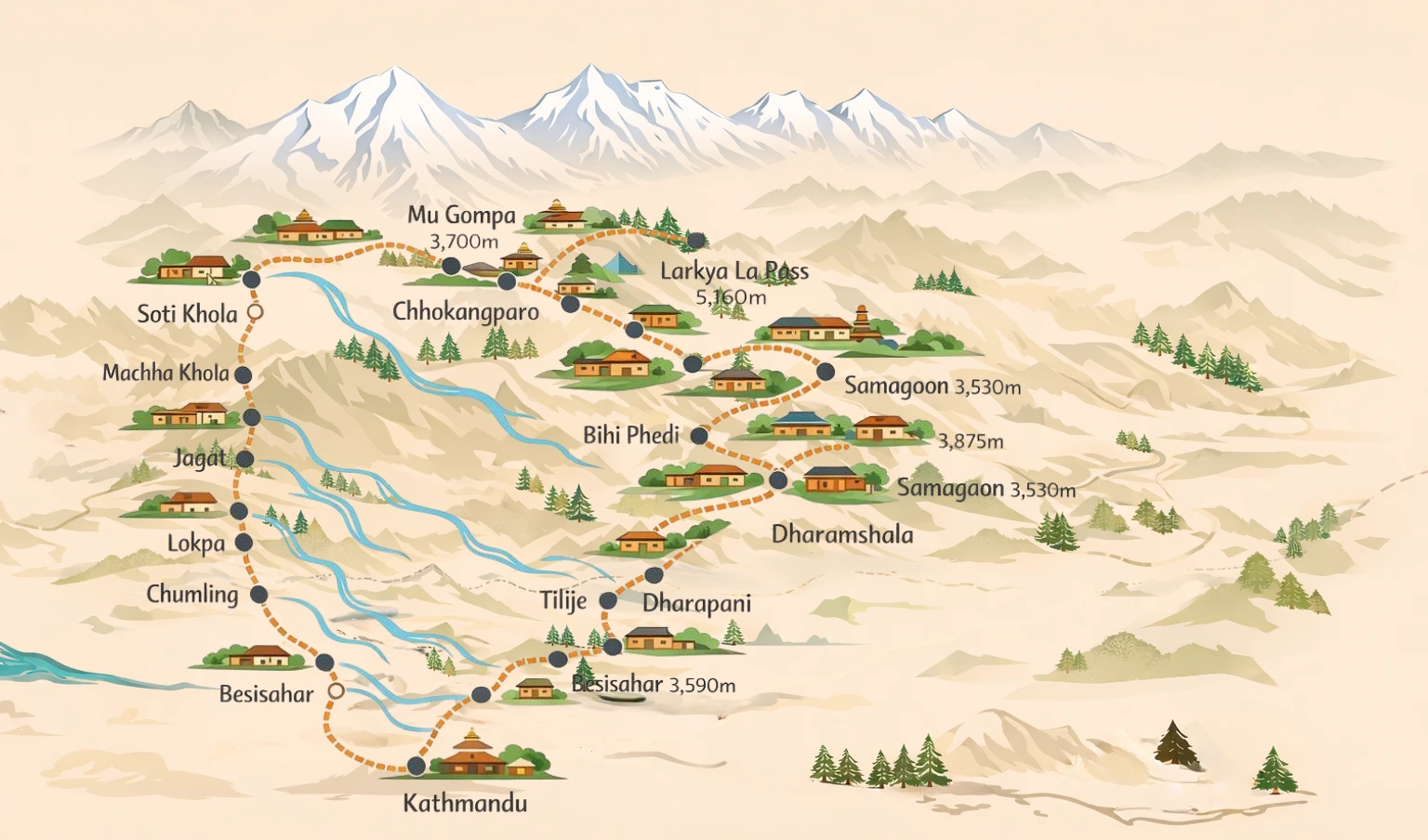
This map (for illustration) shows the complete loop. You begin near Soti/Machha Khola by Kathmandu and head north toward Jagat. One branch goes west into Tsum Valley (Chumling → Chhokangparo → Mu Gompa), then rejoins the main trail. The main trail ascends past Namrung, Samagaon, and over the Larkya La Pass (5,160 m) into the Annapurna region. Key villages (Lokpa, Deng, Namrung, Samdo, Bimtang, Dharapani) and monasteries (Mu Gompa, Pungyen) are marked. Such maps help visualize daily distances and elevation changes.
Chat with us — real trekking experts, not bots.
| Item | Details | Quantity |
| Underwear | Breathable synthetic underwear (BYO) | 3 |
| Socks | Wool trekking socks (BYO) | 3 pairs |
| Bra | Sports bra (BYO) | As needed |
| Base Layer Pants | Merino wool thermal pants (BYO) | 1 |
| Trekking Shirts | Lightweight synthetic shirts; bring your own or buy in Kathmandu | 2 |
| Rain Pants | Lightweight synthetic rain pants; Frogg Toggs work well | 1 |
| Trekking Pants | Lightweight synthetic trekking pants; BYO or purchase in Kathmandu | 2 |
| Hiking Shoes / Boots | Well-fitted trekking boots such as Salomon Quest 4D or X Ultra 3/4 (BYO) | 1 pair |
| Camp Shoes | Down booties or lightweight camp shoes; BYO or buy in Kathmandu | 1 pair |
| Gloves | One thin merino wool pair and one thick insulated pair | 2 pairs |
| Hat | Sun hat or peaked cap with neck protection (BYO) | 1 |
| Down Jacket | Warm insulated down jacket (BYO) | 1 |
| Windbreaker | Lightweight windproof jacket (BYO) | 1 |
Camera or Smartphone: Capture the stunning scenery.
Book or E-reader: Bring your Kindle or favorite book.
Notebook and Pen: Write down your experiences and memories.
Chat with us — real trekking experts, not bots.
Altitude safety and emergency planning are crucial. Beyond common-sense precautions (pace yourself, stay hydrated, sleep well), carry a basic first-aid kit including altitude medication, bandages, painkillers and sunscreen. Listen to your guide, they are trained to recognize altitude sickness. In case of severe symptoms, descent is the immediate remedy.
We provide experienced guides and porters for your security and support. Guides navigate the remote trails, interpret local culture, and ensure everyone adheres to the trek plan. Porters carry extra gear, so you hike lighter, reducing fatigue and risk of injury.
Emergency evacuation: In case of serious injury or illness, evacuation by helicopter is possible but can be delayed by weather. We require trekkers to have travel insurance that covers helicopter rescue. We keep communications open via satellite or mobile (in coverage areas) to arrange help. Our team maintains a safety protocol: daily check-ins, altitude monitoring, and contingency plans for bad weather. With these measures and the guide’s local expertise, you can trek with confidence even in these wild mountains.
Chat with us — real trekking experts, not bots.
Choosing HimalayaHub means expert local support every step of the way. With years of organizing Manaslu and Tsum treks, our team knows the trails, villages and high camps intimately. We hire experienced Nepali guides from the region who speak English and are trained in first aid, they’ll enrich your trek with stories, insights, and swift assistance if needed.
Our approach is ethical and community focused. We walk lightly, contribute to village economies, and respect local customs (for example, supporting Tsum’s no-kill Shyagya tradition). We provide fair wages to porters and buy local supplies en route. Your trip thus benefits Himalayan communities.
HimalayaHub also offers personalized support: from arranging your permits and custom flights/hotels in Kathmandu, to daily logistics on the trail, to 24/7 in-country contact for your questions. Our pre-trip briefing, detailed packing lists, and around-the-clock safety protocols mean you can focus on the adventure.
In short, with HimalayaHub you get years of Nepal trekking experience, strong customer care, and commitment to responsible travel. We’ll make sure your Manaslu Circuit & Tsum Valley journey is not only unforgettable but also smooth, safe, and culturally enriching.
No shared groups. No fixed schedules. Just a personalized journey made for you.
WhatsApp Us
Looking for a Private Tour?
Online now

The starting day of your trek includes your arrival in the capital city of Nepal. You stay overnight at Hotel. Also, you have a choice of taking a short walk through the famous busy alleys or streets here such as the Asan, Thamel, and Basantapur areas.
In the morning, after breakfast, guided sightseeing of the entire Kathmandu valley including the renowned UNESCO world heritage sights – Monkey Temple, Patan Durbar Square, Pashupatinath Temple, Boudhanath Stupa. In the evening, prepare for the trek. Overnight at the hotel.
Early in the morning, we drive from Kathmandu to Sotikhola (700 m). On the way up to Sotikhola, you will pass by a narrow road, fast-flowing rivers, terraced fields, and a suspension bridge. After 8 hours of an exciting drive, you finally reach Soti Khola and take a rest in a hotel or lodge.
The next day, on the fifth day of the Trek. It is the final road hike with Maccha Khola as the destination. After 5 hours of trek, you rest at the hotel. The route passes through densely forested Budhi Gandaki valley and several small villages also observing the Himalayas peaks.
For day 6 you head up towards Jagat. On the way, you can enjoy a natural hot spring, Tato Pani. It takes about 6- 7 hours of trek to reach Jagat which resides at an elevation of 1340m.
You go through the numerous villages while hiking up to Lokpa. The Syar Rivers' junction is seen from the Tsum Valley as the rivers get narrow. To get to Lokpa village, the first settlement in Tsum valley that offers unobstructed views of the Manaslu mountain, we travel down the valley's bank.
The route to Chumling from Lokpa is filled with stunning views of Baudha Himal (6672m) and Ganesh Himal VI. You pass through the Lingwa river valley and climb to a dense rhododendron forest and after many hours of walking settle down in Chumling.
Today, we go across the inner Himalayan region's higher valley. The route continues down to Domje, the biggest city in the Tsum Valley, following the Syar River. We continue to ascend from Domje till we reach Chhokangparo. Chhokangparo offers stunning views of Himalchuli and Ganesh Himal on clear days. Along with Tibetan Chiya (butter tea), traditional cuisine, and the hospitality of the locals are all available to you in Chhokangparo.
The highest point of the Tsum Valley Trek, Mu Gompa, is reached after a short hike from the Chhokanparo along the west side of the valley near the Tibetan border. Through the usually dry and dusty Himalayan environment, we trek up through yak farms. The Mu Gompa monastery offers stunning mountain views and a number of chortens. You also have the chance to visit Dhephu Doma Gompa, one of the Tsum's oldest monasteries.
The next day, you cross the Shikhar river on the upper north Tsum valley. In addition, you get the opportunity to visit historically important places cross a suspension bridge over the Shiar River, and go on through a number of villages until you reach the Nile.
As we approach Gho, we resume our trek from the Nile. To go to Rainjam Village, you will have to cross a suspension bridge close to Gho and continue walking. After leaving Rainjam Village and traveling through Tsum Valley, you arrive in Chumling, where you will spend the rest of the day.
Today's travel should be simpler since you will be leaving Chumling and continuing downward. To go to Lokpa Village, you will be traveling along the Shair Khola's bank. You could come across sizable herds of sheep and goats along the trail on a sunny day. then, you pass Deng(Gurung village) and walk till you reach Bhi-Phedi.
Before taking us to Ghap, the trail begins to meander in and out of the valley canyons and crosses the Serang Khola (2160m). The valley steepens as we make our way out of Ghap and begin the hard climb through bamboo and rhododendron trees. You will arrive at Namrung Village, the gateway to the Nupri area, after crossing a few raging rivers.
You travel through many Mani wall entrance gates, numerous Buddhist Gompas, and a few villages as we depart Namrung. The valley then widens, and Sho Village is on the way. This town is renowned for its stunning views of Manaslu (8163m) and Manaslu North and has a large number of yaks (7,157m). Likewise, the climb and descent through different villages lead you to Samagaon. You will see two rows of houses which is a central part of Samagaon.
An acclimatization day !!! Thousands of mani stones with Buddhist writings and sculptures can be seen in Sama Gaon. Samagaon is a settlement close to Manaslu Base Camp. Today is a day of rest, although you can go on optional excursions to see Birendra Lake or Pungyen Gompa or explore the nearby glacier moraine.
We leave Sama Gaon early in the morning and travel to Samdo. We stroll through the terraced fields next to the ancient mani walls, across the wooden bridge spanning the Budhi Gandaki, and then gradually climb to the Samdo valley.
The climb up to the Larkya La Pass begins at another mani wall. After navigating two streams, you arrive at the Larkya Glacier. Then, you cross the Salka Khola Valley, ascend once more, and arrive at a stone guest house (4,450 m), also known as Larkya La Phedi or Dharmasala, which is not a lodge but more a type of resting spot. You will have stunning views of the Larkya Glacier and the magnificent Manaslu peak today. The next day, we get ready to cross Larkya La Pass while taking a nap in Larkya La Phedi.
The trek begins with a gradual climb across the glacier. Following the slope, we arrive at a hill with prayer flags. You begin the final, difficult climb to the pass after going to the four ice lakes. La Larkya Pass resides at an elevation of 5160m. It’s the highest altitude throughout your whole trek. The pass provides stunning panoramic views of the enormous Annapurna II, Kanguru, Minjung, Himlung Himal, and Cheo Himal. From the top of the pass, we enjoy the breathtaking views. Then take a trail leading downward to Bhimthang.
On day 20, you trek down to Tilije village (2300m) to the high pasture from the rocky terrain of the Himalayan region.
Through a stone bridge, you will leave Tilije and go down the Dudh Khola's embankment as it drops through the scrub forest. The houses of Dharapani eventually become visible in the distance as you continue walking, and the walls of the Marsyangdi Valley start to become larger. You will next cross a wooden bridge and a chorten-shaped bridge to pass Thonje village before arriving at Dharapani.
Finally, you drive for 2 to 3 hours from Dharapani village to Bensishar then around 6 hrs to Kathmandu.
Your Manaslu tsum valley trek is officially ended here.
The best time to trek the Tsum Valley & Manaslu Circuit is during the autumn (September to November) and spring (March to May) seasons. These months offer clear skies, moderate temperatures, and stunning mountain views. Winter months (December to February) can be extremely cold, while the monsoon season (June to August) brings heavy rainfall and challenging trail conditions.
The Tsum Valley & Manaslu Circuit Trek is considered a moderately difficult trek, requiring a good level of physical fitness and prior trekking experience. The route involves several days of walking at high altitudes, with a maximum elevation of 5,160 meters (Larkya La Pass). Proper acclimatization and preparation are essential to handle the altitude and terrain.
While it is possible to trek independently in some regions of Nepal, hiring a guide and porter for the Tsum Valley & Manaslu Circuit Trek is strongly recommended. The region is remote and requires special permits. A guide will ensure safety, provide local insights, and help with the logistical aspects of the trek. Porters can assist in carrying your gear, making the journey more comfortable.
The highest point of the trek is Larkya La Pass (5,160 meters). At this altitude, there is a risk of altitude sickness (AMS), especially if you ascend too quickly. To minimize the risk, the trek includes acclimatization days, such as the rest day in Samagaon. Proper hydration, a gradual ascent, and listening to your body’s signals are crucial for a safe trek.
Accommodation along the Tsum Valley & Manaslu Circuit is typically in teahouses/guesthouses. These simple, family-run lodges provide basic amenities, such as beds, blankets, and shared bathrooms. The rooms are usually clean and comfortable, though more luxurious options are limited in the remote areas. Booking a guide and porter often ensures you get the best available guesthouses.
Packing for the trek requires careful consideration of the varying climate and altitudes. Essential items include:
Warm clothing (layers, down jacket)
Trekking boots
Sleeping bag (available for rent)
Sun protection (sunglasses, sunscreen, hat)
Waterproof gear (rain jacket, poncho)
Personal medications and first aid kit A detailed packing list will be provided upon booking.
Wi-Fi and mobile network service are available in some parts of the trek, particularly in larger villages like Samagaon and Namrung. However, the service is usually intermittent and slower than what you’d find in cities. It’s advisable to carry a local SIM card with data, but be prepared to be offline for long stretches of the trek.
To prepare, engage in physical training focusing on endurance, strength, and cardio. Practice walking long distances with a backpack to simulate the trekking conditions. It’s also important to acclimatize properly by ascending gradually and resting on acclimatization days. Consult your doctor for a health check-up and make sure you have proper travel insurance.
The cost of the trek starts at around $1130 USD per person for an 18-day trek. This includes transportation, guide, permits, accommodation with breakfast, and some gear (sleeping bag and down jacket). Additional costs not included are lunch, dinner, porter fees ($20 USD/day), personal expenses, and travel insurance. Ensure you budget for these extra expenses accordingly.
| # | Discount group | From adult | To adult | Value |
|---|---|---|---|---|
| 1 | Pax | 2 | 5 | ₹128,408.40 |
| 2 | Pax | 6 | 11 | ₹113,871.60 |
| 3 | Pax | 12 | 18 | ₹102,565.20 |

Member Since 2025


Himalaya Hub Kept Coming Up in My Research